This summer we had our baby baptized! Baptism is a big day in the Armenian Church. It is the day that you become a full member of the church. Before I really learned anything at all about the Armenian Church, I knew that I had been baptized, but didn't understand it when my mom told my sister that she couldn't go through the confirmation class/process at the Methodist church my sister and I attended regularly at the time because she had already been confirmed when she was baptized.
Already confirmed? What? To me, confirmation was something that you do in the 3rd or 4th grade, as many of my friends who attended Episcopal or Catholic (or in this case, Methodist) churches did. Confirmation was separate from baptism, something that was set aside for people who were old enough to make the decision to join the church. And those churches who didn't do confirmation didn't have infant baptism anyway, and you only got baptized when you made the decision to get baptized (as my dad did when he was an adult in a Baptist church), so you didn't need a separate confirmation. How could the Armenian Church do it to babies?
When I did more research, I realized that confirmation (called "chrismation" in the Armenian Church) is a separate sacrament, but done at the same time. Chrismation is when the priest marks you with Holy Muron and you are officially a member of the Armenian Church. You also have your first communion when you are baptized (again, a separate sacrament, but done at the same time). This three-in-one ceremony ended up being very very convenient for me, as the last time I attended Badarak before the time I went when I was 22 was when I was in the third grade. Although I didn't know a thing when I started going to Armenian Church, I was already a full-fledged member!
I came to the conclusion that this lack of a separate confirmation ceremony was probably born out of necessity. Or if not as a direct consequence, it sure helped the Armenians maintain their identity through thousands of years. When you are constantly persecuted or under attack, as Armenians have often been in their history, anything that makes membership in a group or organization easier is going to help that organization or community survive. Maybe you didn't have a church near you. Maybe you were forbidden to go, or the church was outlawed. Maybe you had been displaced from your home. All these situations are ones that Armenians have faced in the last century, but they are nothing new.
Just think, though- if you could manage to get to a church, or have a priest secretly visit you, you were home free! And even if you could not get to a church for many years (if ever, if your situation was really bad), you were still a part of something bigger than yourself, part of a greater communion of Armenians.
And this is why I am grateful that I was able to have my daughter baptized into the Armenian Church, but perhaps even more grateful that my 17 month old niece, who lives in the city where I grew up (where there is no Armenian Church parish), was also able to be baptized at the same time. She is, like her mother before her, her grandmother before her, her great-grandmother before her, and back for countless generations, a member of the Armenian Church for life, no matter where she goes or what she does.
Showing posts with label personal. Show all posts
Showing posts with label personal. Show all posts
Sunday, August 08, 2010

Tuesday, March 03, 2009
I have an account on Twitter. It is a general account where I post whatever I want, and not really related to religion or being Armenian, except for when it comes up organically, which sometimes it does (like when I complain about not wanting to go to Armenian lessons).
I posted (tweeted?) a friend about Trader Joe's new maple leaf creme cookies being a terrific chocolate-free dessert for Lent (NB for Armenians- they are also dairy/egg free, shock of shockers, so if you are still eating sugar, fine for us too), and now I have both the Church of England and Westminster Abbey following me! Too funny.
By the way, if you are interested in following me on Twitter, my username is anianiani.
I posted (tweeted?) a friend about Trader Joe's new maple leaf creme cookies being a terrific chocolate-free dessert for Lent (NB for Armenians- they are also dairy/egg free, shock of shockers, so if you are still eating sugar, fine for us too), and now I have both the Church of England and Westminster Abbey following me! Too funny.
By the way, if you are interested in following me on Twitter, my username is anianiani.
Wednesday, February 25, 2009
Almost a year!
Sad, but it has been almost a year now since I have posted. I see a bunch of comments on my last post, but for some reason, blogger doesn't have dates attached to comments. I need to see if I can fix that.
Anyway, I have settled into more of a routine. I switched churches, which I think was a good decision for me; I am just a better fit at the other parish.
I want to say hi to Der Hovnan Demerjian, and give him a special welcome, as I was in the congregation when he celebrated his first Badarak after being ordained the weekend before. I think the Armenian Church is lucky to have such young and energetic champions. My recollection is that he gave a terrific sermon about how we should overcome the conflict between different groups of Armenians and look up to God rather than at the flaws in each other. What a great message!
Growing up in a place with basically no Armenians other than my extended family (plus a few others), I had heard about this eastern/western divide, but I hadn't really seen it in action until I came here. Even in California, at my old church, there wasn't an issue; the priest, like so many younger priests, was from the former USSR. The old core of the church were mostly from the diaspora. No one cared. The priest is a great guy, very devout, very devoted the church, nice, loves kids, etc., etc., basically, everything you would want a priest to be, and that is what people cared about, not where he grew up. I think the respect that we all had for him and his family extended to the other eastern Armenians in our congregation, and I felt that we really were all one family.
Even today, I was hearing people ask each other, "oh, was your mother [town]stantsi?" (I can't remember the town) I am always having to ask people "What does that mean?" because honestly, I didn't grow up with these labels, and I don't know them, and I would rather not. I don't really care.
Anyway, this is the first week of Lent! I already broke the fast accidentally- I got fed at church, and I ate vospov kufta (done w/ chickpeas instead of lentils, though), only to find out that it had been made with chicken broth and butter. Oops! No wonder it tasted so good! I am just doing Wednesdays and Fridays this year (that is the most I have ever done; I am really impressed with people who do all 40 days! Wow!!), but I am determined to do it right this year, at least on Wednesdays and Fridays.
Anyway, I have settled into more of a routine. I switched churches, which I think was a good decision for me; I am just a better fit at the other parish.
I want to say hi to Der Hovnan Demerjian, and give him a special welcome, as I was in the congregation when he celebrated his first Badarak after being ordained the weekend before. I think the Armenian Church is lucky to have such young and energetic champions. My recollection is that he gave a terrific sermon about how we should overcome the conflict between different groups of Armenians and look up to God rather than at the flaws in each other. What a great message!
Growing up in a place with basically no Armenians other than my extended family (plus a few others), I had heard about this eastern/western divide, but I hadn't really seen it in action until I came here. Even in California, at my old church, there wasn't an issue; the priest, like so many younger priests, was from the former USSR. The old core of the church were mostly from the diaspora. No one cared. The priest is a great guy, very devout, very devoted the church, nice, loves kids, etc., etc., basically, everything you would want a priest to be, and that is what people cared about, not where he grew up. I think the respect that we all had for him and his family extended to the other eastern Armenians in our congregation, and I felt that we really were all one family.
Even today, I was hearing people ask each other, "oh, was your mother [town]stantsi?" (I can't remember the town) I am always having to ask people "What does that mean?" because honestly, I didn't grow up with these labels, and I don't know them, and I would rather not. I don't really care.
Anyway, this is the first week of Lent! I already broke the fast accidentally- I got fed at church, and I ate vospov kufta (done w/ chickpeas instead of lentils, though), only to find out that it had been made with chicken broth and butter. Oops! No wonder it tasted so good! I am just doing Wednesdays and Fridays this year (that is the most I have ever done; I am really impressed with people who do all 40 days! Wow!!), but I am determined to do it right this year, at least on Wednesdays and Fridays.
Sunday, January 27, 2008
Quick update
I haven't posted in a while because I have been feeling out of sorts.
I have still been going to church regularly, but it is a struggle to drag my butt there. I am not entirely happy with the church I have been going to, although I thought I had settled on it. I am going to try the other one again sometime soon.
I have been feeling lately like I am really a protestant at heart. Although the protestant revolution wasn't against the Orthodox Church, but the Roman Catholic church, I can really see why people would rebel.
I want the Armenian Church to work out for me; I really do. I put a high cultural value on it, and I had such a wonderful, positive experience at my old church that I want to recapture and have again.
There are a lot of issues going on for me with the church right now. A big part is that it is not social for me AT ALL. I had been warned about this before moving to Boston in general. A lot of people tend to grow up and stay in the area, so they have their own friends and aren't interested in making new ones, so they tend not to be welcoming and friendly to newcomers. (FYI, I know this isn't exclusive to this area; I have heard it's the case in other areas where you have a lot of long-time residents as well). Since I mostly run in academic circles, or other circles where everyone else has moved from somewhere else, I haven't experienced this anywhere else. Church is the one place where it's the case, and I am seeing it there. It just gets kind of tedious. A few people make an effort, but not many others, and no one my age makes an effort at all.
We will see. This isn't the only issue, but it is one of them. I am not giving up yet, but a change of environment may be necessary.
I have still been going to church regularly, but it is a struggle to drag my butt there. I am not entirely happy with the church I have been going to, although I thought I had settled on it. I am going to try the other one again sometime soon.
I have been feeling lately like I am really a protestant at heart. Although the protestant revolution wasn't against the Orthodox Church, but the Roman Catholic church, I can really see why people would rebel.
I want the Armenian Church to work out for me; I really do. I put a high cultural value on it, and I had such a wonderful, positive experience at my old church that I want to recapture and have again.
There are a lot of issues going on for me with the church right now. A big part is that it is not social for me AT ALL. I had been warned about this before moving to Boston in general. A lot of people tend to grow up and stay in the area, so they have their own friends and aren't interested in making new ones, so they tend not to be welcoming and friendly to newcomers. (FYI, I know this isn't exclusive to this area; I have heard it's the case in other areas where you have a lot of long-time residents as well). Since I mostly run in academic circles, or other circles where everyone else has moved from somewhere else, I haven't experienced this anywhere else. Church is the one place where it's the case, and I am seeing it there. It just gets kind of tedious. A few people make an effort, but not many others, and no one my age makes an effort at all.
We will see. This isn't the only issue, but it is one of them. I am not giving up yet, but a change of environment may be necessary.
Sunday, October 07, 2007
Catholicos Visit, Part III
Today was the Hrashapar Badarak today, conducted by His Holiness. Although it was really nice that Vehapar came and was celebrating, I think that the most impressive thing was just bringing all these Armenians together under one roof, in the same building, as one church. Only His Holiness has that kind of influence to get all these people in church on this day.
I also really treasured singing in the choir. GUESS WHO HAD A SOLO???? ME!!! It was one of the two measure amens after Miayn Soorp. I had the "amen" after His Holiness said "Orhnayl Vortit Soorp, Adzvadz jushmarid". I just found out yesterday; it was kind of a last minute thing. I was so honored to have a solo, even a tiny one, during this service. Even if I didn't have a solo, though, I was just so excited to be able to do this. Ever since I found out that Vehapar was coming, I hoped I would be able to sing in the choir for this service.
Working with Maestro Mekanejian was truly an honor and a privilege. I learned so much from working with him, and it was amazing to see such faith in action. This man has so much love not only for the music, but for his church. It was so beautiful. Here is a brief article about Maestro Mekanejian. Truly, if you sing in an Armenian church choir and get the opportunity to take a workshop from him, or work with him in any capacity, you should run and jump on that opportunity.
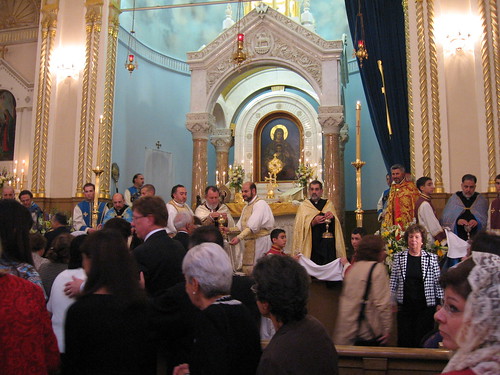
Here is the best picture from all my pictures of Friday and today. It gives you a brief glimpse of the grandness of Holy Trinity in Cambridge. It doesn't do it justice. It is a beautiful church.
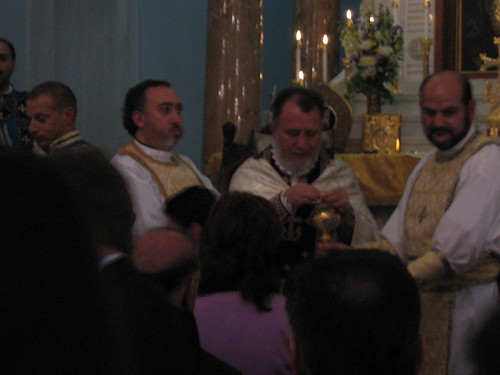
This picture is an okay one, a close-up. I was having trouble getting a good one all zoomed in. The man on the left is Very Rev. Fr. Simeon Odabashian. I don't know who the other one is.
Vehapar's message was about the importance of the Armenian family. With all that Armenians have been through during their history, the family unit has really been the place where Armenian culture and religion was nurtured and preserved. The Armenian view of the family unit is that the father and mother are king and queen of their household, and the children are their subjects over which they rule with paternal/maternal love as the guiding force. Vehapar said that in the kingdom of the family, there are no weapons and no violence. Unfortunately, that isn't the case in all families, but it certainly is the ideal that we should all be striving for. Vehapar said that we need to practice our faith on a daily basis, and this reminds me of something that my mother said my grandmother used to say: "You shouldn't have to tell people that you are Christian. They should know from your actions."
I also really treasured singing in the choir. GUESS WHO HAD A SOLO???? ME!!! It was one of the two measure amens after Miayn Soorp. I had the "amen" after His Holiness said "Orhnayl Vortit Soorp, Adzvadz jushmarid". I just found out yesterday; it was kind of a last minute thing. I was so honored to have a solo, even a tiny one, during this service. Even if I didn't have a solo, though, I was just so excited to be able to do this. Ever since I found out that Vehapar was coming, I hoped I would be able to sing in the choir for this service.
Working with Maestro Mekanejian was truly an honor and a privilege. I learned so much from working with him, and it was amazing to see such faith in action. This man has so much love not only for the music, but for his church. It was so beautiful. Here is a brief article about Maestro Mekanejian. Truly, if you sing in an Armenian church choir and get the opportunity to take a workshop from him, or work with him in any capacity, you should run and jump on that opportunity.
Here is the best picture from all my pictures of Friday and today. It gives you a brief glimpse of the grandness of Holy Trinity in Cambridge. It doesn't do it justice. It is a beautiful church.
This picture is an okay one, a close-up. I was having trouble getting a good one all zoomed in. The man on the left is Very Rev. Fr. Simeon Odabashian. I don't know who the other one is.
Vehapar's message was about the importance of the Armenian family. With all that Armenians have been through during their history, the family unit has really been the place where Armenian culture and religion was nurtured and preserved. The Armenian view of the family unit is that the father and mother are king and queen of their household, and the children are their subjects over which they rule with paternal/maternal love as the guiding force. Vehapar said that in the kingdom of the family, there are no weapons and no violence. Unfortunately, that isn't the case in all families, but it certainly is the ideal that we should all be striving for. Vehapar said that we need to practice our faith on a daily basis, and this reminds me of something that my mother said my grandmother used to say: "You shouldn't have to tell people that you are Christian. They should know from your actions."
Wednesday, August 01, 2007
About Me
I started a new blog about eating in Boston, so I am changing my "About Me" to make it more generic. However, I think that the "about me" that I currently have is really informative for this blog, so I want to save it for posterity.
About Me
I am a half-Armenian woman in her late 20s who, although baptized and chrismated into the Armenian Apostolic Church as an infant, grew up in a town without an Armenian Church. As an adult, I have recently started attending Armenian Church regularly. This blog is about my experiences as a rather late newcomer of sorts to my Mother Church.
About Me
I am a half-Armenian woman in her late 20s who, although baptized and chrismated into the Armenian Apostolic Church as an infant, grew up in a town without an Armenian Church. As an adult, I have recently started attending Armenian Church regularly. This blog is about my experiences as a rather late newcomer of sorts to my Mother Church.
Thursday, March 22, 2007
Lent: Total Failure
So we are almost all the way through Lent (30+ days and counting), and it has been a total bust in terms of eating vegan. I started out with great intentions. I went to Trader Joe's and stocked up on key vegan staples like almond milk (because soy milk tastes nasty) and ready-made lentil dishes. I kept Lent for all of two weeks. And not even the whole two weeks; my goal was just to go vegan (maybe + fish in a pinch, since I knew we'd be travelling) on Wednesdays and Fridays, as recommended by the Eastern Diocese, who seems pretty understanding of the annoyances of cutting out all dairy and meat for almost 6 weeks.
The first week was tough, but no problem. Week two, we were travelling to all the cities where my husband got job offers. It just became impossible, although I did make it through both Wednesday and Friday. We would be eating breakfast somewhere where there was nothing but eggs or cereal (no almond milk) on the menu, people were taking us out for every meal to a restaurant where we often had zero input in choosing, there wouldn't be anything close to vegan on the menu, or even + fish (the fish would inevitably have some kind of brown butter sauce), or I would end up eating tofu and edamame, and that's it. I gave up. I thought I would get back into it when we got back from our 2 week trip, but we had to decide what job offer to take, which was incredibly stressful. A high-class problem, I know. But it was really stressful! I just couldn't handle devoting mental energy to both making this decision and also to holding myself back from eating cheese. Or yogurt. Or milk. Or eggs. I just couldn't do it.
Before we got any job offers but after the interviews, every time I would go to church, I would light a candle and say special prayers during Der Voghormia that my husband would get a really good offer in a place where we both would be happy and do well. He ended up with five offers total, which was amazing, and was selected as one of the top seven people on the job market this year (!!!!). He has worked really hard, but God has also blessed us.
While we were travelling, I made a point to visit whatever Armenian church was in town (all but one university have a church within a 30 minute drive). I visited the one in Cambridge MA, and the one in Trumbull CT (the Trumbull church is the friendliest church I have been to, bar none. I am serious!!!! Lots of people came up to us and talked to us afterwards, without us approaching a soul. Very impressive.). It became really clear to me that this decision was going to be hard, so at both churches, I lit candles and said special Der Voghormia prayers that we would make the right decision.
We have settled on a place; we will be heading to the Glendale of the East- Boston MA. Although the department isn't the best department where he had an offer, we think it is the right department in terms of our global happiness as a couple. I will say special prayers this week of thanksgiving, and also pray that we have made the right decision and that our instincts that we will be happy there are correct.
The first week was tough, but no problem. Week two, we were travelling to all the cities where my husband got job offers. It just became impossible, although I did make it through both Wednesday and Friday. We would be eating breakfast somewhere where there was nothing but eggs or cereal (no almond milk) on the menu, people were taking us out for every meal to a restaurant where we often had zero input in choosing, there wouldn't be anything close to vegan on the menu, or even + fish (the fish would inevitably have some kind of brown butter sauce), or I would end up eating tofu and edamame, and that's it. I gave up. I thought I would get back into it when we got back from our 2 week trip, but we had to decide what job offer to take, which was incredibly stressful. A high-class problem, I know. But it was really stressful! I just couldn't handle devoting mental energy to both making this decision and also to holding myself back from eating cheese. Or yogurt. Or milk. Or eggs. I just couldn't do it.
Before we got any job offers but after the interviews, every time I would go to church, I would light a candle and say special prayers during Der Voghormia that my husband would get a really good offer in a place where we both would be happy and do well. He ended up with five offers total, which was amazing, and was selected as one of the top seven people on the job market this year (!!!!). He has worked really hard, but God has also blessed us.
While we were travelling, I made a point to visit whatever Armenian church was in town (all but one university have a church within a 30 minute drive). I visited the one in Cambridge MA, and the one in Trumbull CT (the Trumbull church is the friendliest church I have been to, bar none. I am serious!!!! Lots of people came up to us and talked to us afterwards, without us approaching a soul. Very impressive.). It became really clear to me that this decision was going to be hard, so at both churches, I lit candles and said special Der Voghormia prayers that we would make the right decision.
We have settled on a place; we will be heading to the Glendale of the East- Boston MA. Although the department isn't the best department where he had an offer, we think it is the right department in terms of our global happiness as a couple. I will say special prayers this week of thanksgiving, and also pray that we have made the right decision and that our instincts that we will be happy there are correct.
Monday, February 05, 2007
The Feast of St. Sarkis
Two Sundays ago was a feast day, celebrating the life of one of the many Armenian martyrs, St. Sarkis. St. Sarkis was a warrior and a Christian, killed by a Persian king after fleeing the Emperor Julian. The lives of the Armenian Saints are filled with stories like these (stories similar to those of the early Saints celebrated by the Catholic church as well)- people being tortured and killed because of their Christian beliefs.
Armenians are not alone in this kind of history; persecution has gone on since the beginning of time, but as a people who have faced it relatively recently in their history, both on a historic scale (e.g. the Genocide), as well as on a small-scale daily basis (Armenians in the Middle East diaspora were Christians surrounded by Muslims, although many, many of them have emigrated elsewhere) we are very sensitive to the necessity of sticking to our beliefs in the face of all outside pressure.
I started writing this post a couple of weeks ago, but the sermon last week tied into the post that I had in mind. It was about St. Sahag, who was Catholicos, was instrumental in the development of the Armenian alphabet by St. Mesrob Mashdots, and the two of them have a joint feast (the Feast of the Holy Translators), although according to my church bulletin, Saturday Feb. 10 was the Feast of Sahag Bartev. So maybe he has his own?
Usually St. Sahag is depicted as one of the main characters who ushered in the "golden age" of Armenian culture, but this week, we were recognizing him for something different. St. Sahag stuck up for the monarchy, which made him really unpopular with the ruling Armenian princes, and eventually had to step down as Catholicos. He maintained his popularity with the people, though, who recognized him as someone who was true to his beliefs.
Historically, in the face of tremendous pressure and persecution, Armenians have remained true to their Christian faith. They have suffered, been discriminated against, and even been killed en masse over it.
I think that this is why,
when two FoxNews reporters were kidnapped by Muslim extremist groups and converted to Islam in order to be released, I did not know if I could have done what they did. I would have felt extremely guilty. Armenian heritage stands upon the bones of many, many people who died rather than betray their faith, what they believed to be true. I think that part of me would have seen conversion, however insincere, to be a betrayal. I know that if I were killed because of a refusal to convert, my husband, father, and mother would all be upset, although maybe my mother would have understood better than anyone else.
The sermon on that day was about St. Sahag, and all people who are truth-tellers. Telling the truth is not always popular; especially when that truth is something that people don't want to hear. Have you ever told a friend or loved one that the person they're dating is controlling or abusive? Just see how popular THAT is. Usually what happens is that the person will quit talking to you, and eventually either break up with or divorce the dodgy significant other. Sometimes your friend will come slinking back, embarrassed by the fact that you were right, but sometimes not.
What was especially interesting about this sermon was that the priest walked his talk. This church is in an extremely, extremely conservative area, and I wouldn't categorize the membership as especially liberal. The priest proceeded to elaborate his message with the modern-day example of the Iraq War, and how no one wanted to come forward to say that it was a bad idea and our reasons for going in were spurious. Those who did say those things were demonized by the administration, but time is bearing them out, and more and more voices are joining in to support them.
I confess that I was shocked. And impressed.
Armenians are not alone in this kind of history; persecution has gone on since the beginning of time, but as a people who have faced it relatively recently in their history, both on a historic scale (e.g. the Genocide), as well as on a small-scale daily basis (Armenians in the Middle East diaspora were Christians surrounded by Muslims, although many, many of them have emigrated elsewhere) we are very sensitive to the necessity of sticking to our beliefs in the face of all outside pressure.
I started writing this post a couple of weeks ago, but the sermon last week tied into the post that I had in mind. It was about St. Sahag, who was Catholicos, was instrumental in the development of the Armenian alphabet by St. Mesrob Mashdots, and the two of them have a joint feast (the Feast of the Holy Translators), although according to my church bulletin, Saturday Feb. 10 was the Feast of Sahag Bartev. So maybe he has his own?
Usually St. Sahag is depicted as one of the main characters who ushered in the "golden age" of Armenian culture, but this week, we were recognizing him for something different. St. Sahag stuck up for the monarchy, which made him really unpopular with the ruling Armenian princes, and eventually had to step down as Catholicos. He maintained his popularity with the people, though, who recognized him as someone who was true to his beliefs.
Historically, in the face of tremendous pressure and persecution, Armenians have remained true to their Christian faith. They have suffered, been discriminated against, and even been killed en masse over it.
I think that this is why,
when two FoxNews reporters were kidnapped by Muslim extremist groups and converted to Islam in order to be released, I did not know if I could have done what they did. I would have felt extremely guilty. Armenian heritage stands upon the bones of many, many people who died rather than betray their faith, what they believed to be true. I think that part of me would have seen conversion, however insincere, to be a betrayal. I know that if I were killed because of a refusal to convert, my husband, father, and mother would all be upset, although maybe my mother would have understood better than anyone else.
The sermon on that day was about St. Sahag, and all people who are truth-tellers. Telling the truth is not always popular; especially when that truth is something that people don't want to hear. Have you ever told a friend or loved one that the person they're dating is controlling or abusive? Just see how popular THAT is. Usually what happens is that the person will quit talking to you, and eventually either break up with or divorce the dodgy significant other. Sometimes your friend will come slinking back, embarrassed by the fact that you were right, but sometimes not.
What was especially interesting about this sermon was that the priest walked his talk. This church is in an extremely, extremely conservative area, and I wouldn't categorize the membership as especially liberal. The priest proceeded to elaborate his message with the modern-day example of the Iraq War, and how no one wanted to come forward to say that it was a bad idea and our reasons for going in were spurious. Those who did say those things were demonized by the administration, but time is bearing them out, and more and more voices are joining in to support them.
I confess that I was shocked. And impressed.
Sunday, February 04, 2007
Back in my day....
I was in a literary society in college- this literary society was the oldest organization at this university (certainly it's the oldest that is still in existence), which is one of the oldest in the country. So this group is OLD. We are talking almost 150 years old here. Members tended to join in their junior or senior year, maybe sophomore year, and rarely, your freshman year (you had to FIND out about the literary society first, and we sometimes frowned upon immature freshman who were applying, since it was no biggie to reapply later).
Due to the old nature of the society and the continually changing membership and changing nature of some of the practices that goes along with that (we did have an official archivist, but you do lose some institutional memory with that kind of turnover), alumni tended to often say the phrase "Back in my day...." even if they had only graduated the year before. It was a running joke.
The sermon in church today was a "back in my day" sermon that did not have a clear message at all. I am back in the Other church now, the one near my university. The priest at this church has been in the US for at least 30 years (I am guessing), which is at least twice as long as the priest at my "home" church. So his English is pretty good, and usually his sermons aren't in bullet point format.
Today, though, he could have taken a leaf from the other Der Hayr's book and used a bullet point. I kept thinking, "What does this have to do with God? Really!"
He started out talking a bit about the Feast of St. Sarkis, which I actually will talk about in another post, and then transitioned to the Super Bowl. Church didn't seem any less full today than normal, even though it was Super Bowl Sunday and there was no Hokehankist (a large reason why many people go to church- to hear Hokehankist for their loved ones). Church isn't normally that full anyway, though.
The whole sermon was one long "Back in my day." Even the talk about St. Sarkis day was introduced by discussing the special candy that they would make back in Beirut (his hometown) for St. Sarkis day.
The talk about the Super Bowl was the strangest, though. He pointed out what a commercial enterprise that the Super Bowl is, and how back at the original Olympics, people just competed for a wreath of laurel that would eventually die, plus the glory of winning. Maybe it's the market economist in me, but I just couldn't really see what was wrong with the Super Bowl being a commercial enterprise. Sure, complain about Christmas or Easter becoming commercialized, but what else is the Super Bowl for? (Also, never mind that the Olympics are ostensibly for amateur athletes, while the Super Bowl is for professionals). I don't think that the Super Bowl was raining down on the church's parade, so I don't know what the problem was exactly.
Due to the old nature of the society and the continually changing membership and changing nature of some of the practices that goes along with that (we did have an official archivist, but you do lose some institutional memory with that kind of turnover), alumni tended to often say the phrase "Back in my day...." even if they had only graduated the year before. It was a running joke.
The sermon in church today was a "back in my day" sermon that did not have a clear message at all. I am back in the Other church now, the one near my university. The priest at this church has been in the US for at least 30 years (I am guessing), which is at least twice as long as the priest at my "home" church. So his English is pretty good, and usually his sermons aren't in bullet point format.
Today, though, he could have taken a leaf from the other Der Hayr's book and used a bullet point. I kept thinking, "What does this have to do with God? Really!"
He started out talking a bit about the Feast of St. Sarkis, which I actually will talk about in another post, and then transitioned to the Super Bowl. Church didn't seem any less full today than normal, even though it was Super Bowl Sunday and there was no Hokehankist (a large reason why many people go to church- to hear Hokehankist for their loved ones). Church isn't normally that full anyway, though.
The whole sermon was one long "Back in my day." Even the talk about St. Sarkis day was introduced by discussing the special candy that they would make back in Beirut (his hometown) for St. Sarkis day.
The talk about the Super Bowl was the strangest, though. He pointed out what a commercial enterprise that the Super Bowl is, and how back at the original Olympics, people just competed for a wreath of laurel that would eventually die, plus the glory of winning. Maybe it's the market economist in me, but I just couldn't really see what was wrong with the Super Bowl being a commercial enterprise. Sure, complain about Christmas or Easter becoming commercialized, but what else is the Super Bowl for? (Also, never mind that the Olympics are ostensibly for amateur athletes, while the Super Bowl is for professionals). I don't think that the Super Bowl was raining down on the church's parade, so I don't know what the problem was exactly.
Thursday, January 18, 2007
The Voch/Che Debate
Way back in an earlier post, I mentioned that I had gotten some conflicting information about when to use "voch" and when to use "che." Voch is the formal way to say "no", and che is the informal way. Che literally means "it's not."
My mom told me a while ago that she was not allowed to say "voch" at home, that her mother said that "brats say voch." The people at church thought this was strange, because voch is more proper.
Over Thanksgiving, my mom's older sister and her husband were visiting, and I asked her about voch/che. This particular sister is really, really into being Armenian, and is also very bright, so I knew she would be able to help me.
Mystery solved. The people at church were right. My mom wasn't allowed to say voch, but not because it was rude per se, it was because she was not allowed to say no to her mother. If her mother asked her to do something, the answer always had to be "ayo!" (yes). Voch = talking back.
This conversation then launched into a discussion about how my grandmother was so much stricter with the older girls than with my mom, who was the baby. The older girls were not even allowed to give their mom a dirty look. My aunt (third child, second oldest girl, 8 years older than my mother) was saying that she could not speak her mind at all, had to keep her mouth shut, could not even look at their mom funny. Total obedience. However, my mom was able to pretty much do what she wanted.
I laughed and laughed and laughed on the inside at this story, because I would say that when my sister and I were growing up, my mother's expectations were definitely closer to how my aunt described those for the older girls than those for my mother. We were not allowed to say no either! Always yes.
My mom told me a while ago that she was not allowed to say "voch" at home, that her mother said that "brats say voch." The people at church thought this was strange, because voch is more proper.
Over Thanksgiving, my mom's older sister and her husband were visiting, and I asked her about voch/che. This particular sister is really, really into being Armenian, and is also very bright, so I knew she would be able to help me.
Mystery solved. The people at church were right. My mom wasn't allowed to say voch, but not because it was rude per se, it was because she was not allowed to say no to her mother. If her mother asked her to do something, the answer always had to be "ayo!" (yes). Voch = talking back.
This conversation then launched into a discussion about how my grandmother was so much stricter with the older girls than with my mom, who was the baby. The older girls were not even allowed to give their mom a dirty look. My aunt (third child, second oldest girl, 8 years older than my mother) was saying that she could not speak her mind at all, had to keep her mouth shut, could not even look at their mom funny. Total obedience. However, my mom was able to pretty much do what she wanted.
I laughed and laughed and laughed on the inside at this story, because I would say that when my sister and I were growing up, my mother's expectations were definitely closer to how my aunt described those for the older girls than those for my mother. We were not allowed to say no either! Always yes.
Wednesday, January 10, 2007
On Being A Visitor
While we were away last week, I took the opportunity to visit a local Armenian Church to celebrate the Theophany, and get my yearly rationing of holy water. I was pleasantly surprised at how friendly and welcoming this church was. This is the first time I've been to an Armenian Church where someone actually talked to me first. I admit, I was shocked. Before I even sat down, someone came over to introduce himself and ask me where I was from, etc. Turns out there had been a young adult party at his house the night before, and he also had another person there who was in town for the same conference that brought me to the area.
Since I like to give credit where credit is due, the church I visited was St. James Armenian Church in Evanston, IL. They have a young priest (a "Deacon-in-Charge" actually, which seems to be the step before becoming a Der Hayr? Not sure.), but on Sunday, they had a visiting priest from Detroit conducting Badarak.
In my regular church, the way they get through the service in the fastest way possible is to leave things out. For instance, instead of starting with Khorhoort Khoreen (Profound Mystery), we start with Miadzin Vorti (Only Begotten Son). This visiting priest, who was not very young (to be polite), had been around (in a church way), so his method of keeping the service snappy was to say the whole thing very, very fast. I was following along with the pew book (the brown one!), and it was tough. He was going FAST. Not just normal quick conversational speed, but the speed you hear when someone is saying the fine print at the end of a radio commercial.
Because it was Christmas, church was packed. It wasn't a big church (at least, the sanctuary wasn't big; the building itself seemed like it had lots of room), and you could tell by looking at the outside of the church that it hadn't originally been an Armenian church. If an Armenian church is built to be an Armenian Church, it is built in a very specific style. However, Armenians are a resilient people, so we will happily take a church that used to be Methodist, Baptist, Episcopal, or whatever this denomination used to worship there, and make it our own. On the inside, it looked like the other Armenian churches that I had been to. You have a place to light candles (where in the church this is located seems to vary from church to church), a raised platform where the faithful go up and receive communion and where the priest gives his sermon (this is one step up higher from where the congregation sits), and then you have the altar, which is raised up much higher than the congregation. You have to climb several steps to get up there, usually 3-5. You have the curtain that gets closed during part of Badarak (or the whole Badarak, as happens during Lent), the marble-looking altar thing (surely it can't really be marble, can it?), the gold crosses, the picture of Jesus and Mary (this church had a very European, Vermeerish looking picture instead of a more traditional Eastern-style, 2-dimensional iconograph).
When Badarak started, I was the only person in the congregation. No real surprise, since Armenians always run late. The church gradually filled up, and I ended up sharing my pew book with a Northwestern Ph.D. student originally from Glendale. I could tell from the way she was sneaking looks at my pew book that she needed one too, so I asked her if she wanted to share. Even though I have been attending church regularly for over a year now, I still need the book to know where we are, what is happening.
On the train from downtown, I was cramming like crazy to learn the two lines I needed to learn. First was the Christmas exchange. It goes like this:
Armenian #1: Krisdos dznav yev haydnetsav! (Christ is born and revealed among us!)
Armenian #2: Orhnyal eh haydnotyoonun Krisdosee! (Blessed is the revelation of Christ!)
I figured that I didn't really need to wish anyone Merry Christmas, so all I had to learn was the response, which was the same as the other exchange I was trying to learn last minute, the exchange for the Kiss of Peace. Protestant/Catholic churches also do some kind of passing/exchanging peace, usually consisting of shaking the hands of your neighbors seated around you and saying "Peace be with you." In the Episcopal churches that I have attended, Exchanging the Peace practically turns into coffee hour, with everyone going all over the church to say hi to their friends, talking to random strangers, and it tends to go on for 5 minutes or so, until the priest reins them all in.
In the Armenian Church, despite our deserved reputation for being loud, noisy, and social, we are very regimented when it comes to the Kiss of Peace. The deacon-in-charge (not always the priest) usually goes down, and starts the chain by "kissing" two of the other deacons, who then go out and distribute the "kiss" in the manner of playing Telephone down each row.
Let me clarify. There is no actual kissing involved. It's basically the miming of a European-style, double-kiss greeting on both cheeks, but instead of kissing, the person doing the kissing whispers Krisdos ee mech mer haydnetsav (Christ is revealed among us).
Then, the person receiving the kiss whispers back the same line you reply with for Christmas: Orhnyal eh haydnootyoonun Krisdosee. After you receive the kiss, you turn to your neighbor, move your face from one of their cheeks to the other, whispering Krisdos ee mech mer haydnetsav, and they reply back Orhnyal eh haydnootyoonun Krisdosee, and repeat.
The reason why I don't know these two lines is because a) Christmas only comes once a year, so it's not like I get to practice and b) with the Kiss of Peace, being in the Choir gets me out of participating, so I never had to learn. (It is kind of a relief- one fewer thing that I have to screw up on a regular basis). On the one hour train ride from downtown Chicago to Evanston, I kept repeating (sometimes out loud, but quietly) "Orhnyal eh haydnootyuonun Krisdosee! HaydnooTYUNun. HaydnooTYUNun. HaydnooTYUNun." And then I get to church, and I STILL screw it up. No one seemed to mind, though, and when the "kisser" got to me, he said it in English to make sure I understood.
Afterwards, I went up to the Deacon-in-charge and told him that he had a very friendly church, and I was very impressed. He asked my name, and I told him, and then he asked my last name. I repeated my very, very WASPY, not Armenian at all, last name (both married and maiden name are this way), and added "I am only half Armenian." He told me that did not matter at all, and not to even mention it, I was still Armenian, etc. My sister, in all of her experiences with the youth programs with the Eastern Diocese, has said that this attitude of "We're all Armenians!" is not universal, so I admit that I kind of expect it wherever I go. I'm only half, I don't speak much Armenian, etc. I told him "Keech me ge khosim." (I speak a little), and hey, he was happy.
My husband and I are just starting the process of finding out where we will be living starting next year. I am pleased to realize that everywhere he is interviewing is no more than about an hour away from an Armenian Church, and most are much closer than that.
Since I like to give credit where credit is due, the church I visited was St. James Armenian Church in Evanston, IL. They have a young priest (a "Deacon-in-Charge" actually, which seems to be the step before becoming a Der Hayr? Not sure.), but on Sunday, they had a visiting priest from Detroit conducting Badarak.
In my regular church, the way they get through the service in the fastest way possible is to leave things out. For instance, instead of starting with Khorhoort Khoreen (Profound Mystery), we start with Miadzin Vorti (Only Begotten Son). This visiting priest, who was not very young (to be polite), had been around (in a church way), so his method of keeping the service snappy was to say the whole thing very, very fast. I was following along with the pew book (the brown one!), and it was tough. He was going FAST. Not just normal quick conversational speed, but the speed you hear when someone is saying the fine print at the end of a radio commercial.
Because it was Christmas, church was packed. It wasn't a big church (at least, the sanctuary wasn't big; the building itself seemed like it had lots of room), and you could tell by looking at the outside of the church that it hadn't originally been an Armenian church. If an Armenian church is built to be an Armenian Church, it is built in a very specific style. However, Armenians are a resilient people, so we will happily take a church that used to be Methodist, Baptist, Episcopal, or whatever this denomination used to worship there, and make it our own. On the inside, it looked like the other Armenian churches that I had been to. You have a place to light candles (where in the church this is located seems to vary from church to church), a raised platform where the faithful go up and receive communion and where the priest gives his sermon (this is one step up higher from where the congregation sits), and then you have the altar, which is raised up much higher than the congregation. You have to climb several steps to get up there, usually 3-5. You have the curtain that gets closed during part of Badarak (or the whole Badarak, as happens during Lent), the marble-looking altar thing (surely it can't really be marble, can it?), the gold crosses, the picture of Jesus and Mary (this church had a very European, Vermeerish looking picture instead of a more traditional Eastern-style, 2-dimensional iconograph).
When Badarak started, I was the only person in the congregation. No real surprise, since Armenians always run late. The church gradually filled up, and I ended up sharing my pew book with a Northwestern Ph.D. student originally from Glendale. I could tell from the way she was sneaking looks at my pew book that she needed one too, so I asked her if she wanted to share. Even though I have been attending church regularly for over a year now, I still need the book to know where we are, what is happening.
On the train from downtown, I was cramming like crazy to learn the two lines I needed to learn. First was the Christmas exchange. It goes like this:
Armenian #1: Krisdos dznav yev haydnetsav! (Christ is born and revealed among us!)
Armenian #2: Orhnyal eh haydnotyoonun Krisdosee! (Blessed is the revelation of Christ!)
I figured that I didn't really need to wish anyone Merry Christmas, so all I had to learn was the response, which was the same as the other exchange I was trying to learn last minute, the exchange for the Kiss of Peace. Protestant/Catholic churches also do some kind of passing/exchanging peace, usually consisting of shaking the hands of your neighbors seated around you and saying "Peace be with you." In the Episcopal churches that I have attended, Exchanging the Peace practically turns into coffee hour, with everyone going all over the church to say hi to their friends, talking to random strangers, and it tends to go on for 5 minutes or so, until the priest reins them all in.
In the Armenian Church, despite our deserved reputation for being loud, noisy, and social, we are very regimented when it comes to the Kiss of Peace. The deacon-in-charge (not always the priest) usually goes down, and starts the chain by "kissing" two of the other deacons, who then go out and distribute the "kiss" in the manner of playing Telephone down each row.
Let me clarify. There is no actual kissing involved. It's basically the miming of a European-style, double-kiss greeting on both cheeks, but instead of kissing, the person doing the kissing whispers Krisdos ee mech mer haydnetsav (Christ is revealed among us).
Then, the person receiving the kiss whispers back the same line you reply with for Christmas: Orhnyal eh haydnootyoonun Krisdosee. After you receive the kiss, you turn to your neighbor, move your face from one of their cheeks to the other, whispering Krisdos ee mech mer haydnetsav, and they reply back Orhnyal eh haydnootyoonun Krisdosee, and repeat.
The reason why I don't know these two lines is because a) Christmas only comes once a year, so it's not like I get to practice and b) with the Kiss of Peace, being in the Choir gets me out of participating, so I never had to learn. (It is kind of a relief- one fewer thing that I have to screw up on a regular basis). On the one hour train ride from downtown Chicago to Evanston, I kept repeating (sometimes out loud, but quietly) "Orhnyal eh haydnootyuonun Krisdosee! HaydnooTYUNun. HaydnooTYUNun. HaydnooTYUNun." And then I get to church, and I STILL screw it up. No one seemed to mind, though, and when the "kisser" got to me, he said it in English to make sure I understood.
Afterwards, I went up to the Deacon-in-charge and told him that he had a very friendly church, and I was very impressed. He asked my name, and I told him, and then he asked my last name. I repeated my very, very WASPY, not Armenian at all, last name (both married and maiden name are this way), and added "I am only half Armenian." He told me that did not matter at all, and not to even mention it, I was still Armenian, etc. My sister, in all of her experiences with the youth programs with the Eastern Diocese, has said that this attitude of "We're all Armenians!" is not universal, so I admit that I kind of expect it wherever I go. I'm only half, I don't speak much Armenian, etc. I told him "Keech me ge khosim." (I speak a little), and hey, he was happy.
My husband and I are just starting the process of finding out where we will be living starting next year. I am pleased to realize that everywhere he is interviewing is no more than about an hour away from an Armenian Church, and most are much closer than that.
Monday, November 13, 2006
Armenian Funerals
I went to my second Armenian funeral last week, for the 21 year old deacon who died. The first Armenian funeral I attended was for my grandfather, and it was an Armenian priest that my family had flown into town to do the service. (Hayr Simeon is a great guy, by the way, and I love his philosophy on getting people involved with the church. If you live in the Providence, RI area, you should definitely check out his church.)
The viewing was on Wednesday night, and the funeral was on Thursday. Wednesday night wasn't really a "viewing," though, as the casket was closed, and it was mostly people talking about this young man (some in Armenian, and some in English), like would happen at a regular funeral. Even the Archbishop was there. The church was PACKED both Wednesday night and Thursday morning. I sang with the choir on Thursday- We sang just Kahanayk and Ee Verin Yeroosaghem.
Ee Verin Yeroosaghem is probably one of my favorite hymns in the Armenian Church. The translation is:
In the Heavenly Jerusalem, in the abode of angels, where Enoch and Elijah live dove-like in old age, being worthily resplendent in the Garden of Eden; O merciful Lord, have mercy upon the souls of our departed brethren.
The imagery is so beautiful- angels, doves, resplendent gardens... it's a reminder of beauty in an otherwise pretty gloomy service.
There is a big difference between funerals for old people (like my grandfather) and young people (like this 21 year old deacon). You expect old people to die; that is what happens when you are old. You don't expect young people to die; you expect them to graduate from college, travel, buy first houses, get married, have babies, get promoted, etc. Funerals for young people are shocking to the system. Even if it's not your first funeral for a young person, it's still pretty horrifying. Just seeing all his young friends, only about 5-7 years younger than I am, going through this was just really upsetting. There was a huge HUGE presence of the Homenetmen; they had the flags of all the local chapters, plus another one from elsewhere in the state, on display by the coffin, all the scouts were there in their uniforms, and they had draped a Homenetmen flag on his coffin.
Almost all the service was in Armenian again, except for one of the priests (the former priest of this church), who graciously translated his speech into English. This was much appreciated by me (and I am sure by the deceased non-Armenian friends), not only b/c it meant that I would understand what was going on, but because I didn't really know this young man, so it was nice to hear comments from people who did know him.
I was fine until the end, when his pallbearing young friends went to get the coffin. No one should have to be a pallbearer for their friend at that young of an age. It is just not fair. I started crying, and his mother lost it. The family was practically restraining her from throwing herself on the coffin. She was screaming and crying. Naturally. At first I had kind of a negative reaction to this, but then I thought, "If there is ever at time when screaming and bawling is warranted, it's now. Why should she try to hold everything in? Let her scream and cry." I told my husband this, and he said that he was reminded of the show Six Feet Under- whenever anyone at a funeral starts to lose it, David will hurry them off to the private room off to the side so they don't make anyone uncomfortable, and Nate gets mad, because it is all so fake to stifle grief like that. Death is sad. Let people be sad.
There was a lot of emphasis in the services on "he is in a better place now." This always annoys me, because this is supposed to make me feel BETTER? I am selfish- I want (whoever) here with me NOW. I told my husband that if I die early, my funeral is not to be entirely in Armenian, and that none of this "better place" crap.
The viewing was on Wednesday night, and the funeral was on Thursday. Wednesday night wasn't really a "viewing," though, as the casket was closed, and it was mostly people talking about this young man (some in Armenian, and some in English), like would happen at a regular funeral. Even the Archbishop was there. The church was PACKED both Wednesday night and Thursday morning. I sang with the choir on Thursday- We sang just Kahanayk and Ee Verin Yeroosaghem.
Ee Verin Yeroosaghem is probably one of my favorite hymns in the Armenian Church. The translation is:
In the Heavenly Jerusalem, in the abode of angels, where Enoch and Elijah live dove-like in old age, being worthily resplendent in the Garden of Eden; O merciful Lord, have mercy upon the souls of our departed brethren.
The imagery is so beautiful- angels, doves, resplendent gardens... it's a reminder of beauty in an otherwise pretty gloomy service.
There is a big difference between funerals for old people (like my grandfather) and young people (like this 21 year old deacon). You expect old people to die; that is what happens when you are old. You don't expect young people to die; you expect them to graduate from college, travel, buy first houses, get married, have babies, get promoted, etc. Funerals for young people are shocking to the system. Even if it's not your first funeral for a young person, it's still pretty horrifying. Just seeing all his young friends, only about 5-7 years younger than I am, going through this was just really upsetting. There was a huge HUGE presence of the Homenetmen; they had the flags of all the local chapters, plus another one from elsewhere in the state, on display by the coffin, all the scouts were there in their uniforms, and they had draped a Homenetmen flag on his coffin.
Almost all the service was in Armenian again, except for one of the priests (the former priest of this church), who graciously translated his speech into English. This was much appreciated by me (and I am sure by the deceased non-Armenian friends), not only b/c it meant that I would understand what was going on, but because I didn't really know this young man, so it was nice to hear comments from people who did know him.
I was fine until the end, when his pallbearing young friends went to get the coffin. No one should have to be a pallbearer for their friend at that young of an age. It is just not fair. I started crying, and his mother lost it. The family was practically restraining her from throwing herself on the coffin. She was screaming and crying. Naturally. At first I had kind of a negative reaction to this, but then I thought, "If there is ever at time when screaming and bawling is warranted, it's now. Why should she try to hold everything in? Let her scream and cry." I told my husband this, and he said that he was reminded of the show Six Feet Under- whenever anyone at a funeral starts to lose it, David will hurry them off to the private room off to the side so they don't make anyone uncomfortable, and Nate gets mad, because it is all so fake to stifle grief like that. Death is sad. Let people be sad.
There was a lot of emphasis in the services on "he is in a better place now." This always annoys me, because this is supposed to make me feel BETTER? I am selfish- I want (whoever) here with me NOW. I told my husband that if I die early, my funeral is not to be entirely in Armenian, and that none of this "better place" crap.
Tuesday, November 07, 2006
Women in the Church
Like other Orthodox churches and the Roman Catholic church, the Armenian Apostolic church does not allow women to become priests. Women/girls are also technically not allowed up on the altar, BUT one of the churches I go to has a little girl who occasionally is up there helping, and has girls do the readings sometimes, etc. I don't see any adolescent girls or grown women up there, but considering there are very few youths/young adults of either gender who participate in church, even just by going, so it may not be an age thing.
I surprise myself, but the fact that women are not allowed to be priests does not bother me (although I sometimes think it should...). I think this is due to two things: 1) the nature of the duties of the priesthood and 2) the nature of church life.
First, the nature of the priesthood. As far as I can tell, priests in the Armenian church perform many of the same functions of their counterparts in the Roman Catholic and Protestant churches, except for one. Sermons. There are still sermons in the Armenian church, but they are significantly shorter and less important than they are in, say, my parents' Southern Baptist church. That is, the Armenian church is NOT about preaching. Some priests are naturally good at giving sermons, and some are not, but you don't have to be especially good at them to succeed as a priest. This means that if someone is called to spread the word of God, or to teach others, etc., there are other venues to do that, probably BETTER venues for doing that, than becoming a priest. The choir serves an incredibly important function in the service- I would argue that they are just as important to the service as the altar boys, so I don't exactly feel that I am being excluded from participating actively in the service the way I might in a Roman Catholic or Protestant church where the hymns are just nice little additions to the service.
There is also complete acknowledgement of the role that women play in generally sustaining the church. Well, this is the case at the two churches that I attend regularly, anyway. Maybe it isn't in other churches. Everyone knows that they might not be up on the altar, but really, there would be no churches without them. The women are the ones who run the church office, teach Sunday School and Armenian School, and coordinate fundraisers, among other things. At a recent Armenian festival at another local church that I don't attend, my husband and I noticed the women running around cooking and serving food (the main way that the festival raised money was by selling dinner!), while the men stood around in black, wearing black vests with SECURITY on the back in big white letters, smoking cigars or drinking. Not kidding. My husband wondered if the festival really needed that much security. I said that probably it was the only way the women could get their husbands and grown sons to help out. "Oh, you can work security!" In both the churches I attend, the Parish Councils have women, so they contribute to running the church as well. The Armenian Church even has a special title for the Der Hayr's wife- Yeretzgin. Jews also have a similar title for a Rabbi's wife- Rebbetzin. Protestant churches don't have this- there is no real recognition of the support and sacrifices that the wife of a minister (because although I know some female Protestant ministers, I don't really see their husbands doing so much of the day-to-day support, coordination, mentoring level that the wives of male ministers often do) makes. I like that the Armenian Church says, "hey, the wife of a priest is a real position of responsibility too!"
While I do have issues with the very old-world view of women in general (particularly when it comes to how sons are treasured versus daughters), I think that church life, and maybe only in church life, are the contributions of women, even though they are separate and not always equal (often they are greater), usually recognized and appreciated for what they are. Plus, since churches are usually on the small side, talent doesn't get lost in the herd, whether it is male or female. Maybe this is why I think that the women are appreciated? They can't afford to piss them off.
This is not to say that I don't think that girls shouldn't be on the altar- I do! I am glad that there are a few churches who break/bend this rule to a certain extent. Or that I don't care that the men are happy to sit around and smoke and drink and wear SECURITY vests rather than pitching in with the real grunt work. I am indifferent about women becoming priests, I think because there are so many opportunities to express a call for anything, and you can still go to St. Nersess seminary and take classes and get a degree if you are a woman (I know they have a layperson's track and a priest track- I am not sure if women can do the priest track, even though they obviously won't become priests).
One positive thing about the Armenian Church is that often they are not big churches, which means that any one individual person has a greater opportunity to make a concrete difference in the environment of a church. Each person can be more welcoming, can reach out to new people/strangers. You can work to organize activities to get people involved. You may not be able to change the entire culture and structure of the church, but you can make the church your own.
It is late. I might go back and edit this post later, for fear that it is incoherent, but I wanted to get it up there. I've been promising it for a while.
I surprise myself, but the fact that women are not allowed to be priests does not bother me (although I sometimes think it should...). I think this is due to two things: 1) the nature of the duties of the priesthood and 2) the nature of church life.
First, the nature of the priesthood. As far as I can tell, priests in the Armenian church perform many of the same functions of their counterparts in the Roman Catholic and Protestant churches, except for one. Sermons. There are still sermons in the Armenian church, but they are significantly shorter and less important than they are in, say, my parents' Southern Baptist church. That is, the Armenian church is NOT about preaching. Some priests are naturally good at giving sermons, and some are not, but you don't have to be especially good at them to succeed as a priest. This means that if someone is called to spread the word of God, or to teach others, etc., there are other venues to do that, probably BETTER venues for doing that, than becoming a priest. The choir serves an incredibly important function in the service- I would argue that they are just as important to the service as the altar boys, so I don't exactly feel that I am being excluded from participating actively in the service the way I might in a Roman Catholic or Protestant church where the hymns are just nice little additions to the service.
There is also complete acknowledgement of the role that women play in generally sustaining the church. Well, this is the case at the two churches that I attend regularly, anyway. Maybe it isn't in other churches. Everyone knows that they might not be up on the altar, but really, there would be no churches without them. The women are the ones who run the church office, teach Sunday School and Armenian School, and coordinate fundraisers, among other things. At a recent Armenian festival at another local church that I don't attend, my husband and I noticed the women running around cooking and serving food (the main way that the festival raised money was by selling dinner!), while the men stood around in black, wearing black vests with SECURITY on the back in big white letters, smoking cigars or drinking. Not kidding. My husband wondered if the festival really needed that much security. I said that probably it was the only way the women could get their husbands and grown sons to help out. "Oh, you can work security!" In both the churches I attend, the Parish Councils have women, so they contribute to running the church as well. The Armenian Church even has a special title for the Der Hayr's wife- Yeretzgin. Jews also have a similar title for a Rabbi's wife- Rebbetzin. Protestant churches don't have this- there is no real recognition of the support and sacrifices that the wife of a minister (because although I know some female Protestant ministers, I don't really see their husbands doing so much of the day-to-day support, coordination, mentoring level that the wives of male ministers often do) makes. I like that the Armenian Church says, "hey, the wife of a priest is a real position of responsibility too!"
While I do have issues with the very old-world view of women in general (particularly when it comes to how sons are treasured versus daughters), I think that church life, and maybe only in church life, are the contributions of women, even though they are separate and not always equal (often they are greater), usually recognized and appreciated for what they are. Plus, since churches are usually on the small side, talent doesn't get lost in the herd, whether it is male or female. Maybe this is why I think that the women are appreciated? They can't afford to piss them off.
This is not to say that I don't think that girls shouldn't be on the altar- I do! I am glad that there are a few churches who break/bend this rule to a certain extent. Or that I don't care that the men are happy to sit around and smoke and drink and wear SECURITY vests rather than pitching in with the real grunt work. I am indifferent about women becoming priests, I think because there are so many opportunities to express a call for anything, and you can still go to St. Nersess seminary and take classes and get a degree if you are a woman (I know they have a layperson's track and a priest track- I am not sure if women can do the priest track, even though they obviously won't become priests).
One positive thing about the Armenian Church is that often they are not big churches, which means that any one individual person has a greater opportunity to make a concrete difference in the environment of a church. Each person can be more welcoming, can reach out to new people/strangers. You can work to organize activities to get people involved. You may not be able to change the entire culture and structure of the church, but you can make the church your own.
It is late. I might go back and edit this post later, for fear that it is incoherent, but I wanted to get it up there. I've been promising it for a while.
Sliding Doors
Do you have anyone in your life that looms large, even in their absence? This is my grandmother, a woman whom I never met. My mother was very close to her; she considered her mother her best friend, and she was just torn apart when her mom died of cancer. It was one of those situations when the cancer was diagnosed very late, and she was gone within a couple of months.
From all reports, everyone loved my grandmother, and she was the glue that held the family together, and to a certain extent, the glue that held my mother together. When she died, the family came apart; my mother came apart. Both held themselves together reasonably well, but like the bowl you drop and try to repair, only to find that you are missing a small yet crucial piece that you just can't find anywhere, neither were ever quite whole again.
My mother came apart right away, but the family took much longer. My mom has said that she never had anything bad happen to her before her mother died, and it was a serious shock to the system. She said that she slept with the hallway light on for two years. I was born a few years after my grandmother died, and my sister within two years after my birth, and this was also very traumatizing for my mother; although the birth of children was very joyous for her, she was very upset and angry because she had always imagined her mother there helping her, and instead, she was all alone. Although she had a sister, a sister-in-law, and an aunt who were all nearby and alive when my sister and I were little, for several reasons, these were not trusted sources of support. My mother eventually developed agoraphobia. I didn't realize this at the time; all I knew was that every time we were supposed to go do something fun (go shopping, etc.), mom got sick, and we couldn't go after all. Yet she was never incapacitated when we had to do boring, decidedly un-fun things, like cleaning. My mother eventually got treatment for this when I was about 12, and it completely changed everyone's lives.
Sometimes, I imagine what my life would be like if my grandmother had not died at the untimely age of 52. I imagine my life just like the movie Sliding Doors, where you see how Gwyneth Paltrow's character's life unfolds when she misses the subway train, and also how it would unfold if she made the train. What if my grandmother was still alive today? It would be theoretically possible, if not for the non-Hodgkin's lymphoma. She would be 84 today. Not young, but still young enough to possibly be around. My grandfather (her widower) only died 2 years ago, at the age of 99.
Here are the main things that I think would have been different:
I don't think that all these changes would have been for the better (some would have been for sure), but like all imaginary lives, we will never know for sure what would happen.
From all reports, everyone loved my grandmother, and she was the glue that held the family together, and to a certain extent, the glue that held my mother together. When she died, the family came apart; my mother came apart. Both held themselves together reasonably well, but like the bowl you drop and try to repair, only to find that you are missing a small yet crucial piece that you just can't find anywhere, neither were ever quite whole again.
My mother came apart right away, but the family took much longer. My mom has said that she never had anything bad happen to her before her mother died, and it was a serious shock to the system. She said that she slept with the hallway light on for two years. I was born a few years after my grandmother died, and my sister within two years after my birth, and this was also very traumatizing for my mother; although the birth of children was very joyous for her, she was very upset and angry because she had always imagined her mother there helping her, and instead, she was all alone. Although she had a sister, a sister-in-law, and an aunt who were all nearby and alive when my sister and I were little, for several reasons, these were not trusted sources of support. My mother eventually developed agoraphobia. I didn't realize this at the time; all I knew was that every time we were supposed to go do something fun (go shopping, etc.), mom got sick, and we couldn't go after all. Yet she was never incapacitated when we had to do boring, decidedly un-fun things, like cleaning. My mother eventually got treatment for this when I was about 12, and it completely changed everyone's lives.
Sometimes, I imagine what my life would be like if my grandmother had not died at the untimely age of 52. I imagine my life just like the movie Sliding Doors, where you see how Gwyneth Paltrow's character's life unfolds when she misses the subway train, and also how it would unfold if she made the train. What if my grandmother was still alive today? It would be theoretically possible, if not for the non-Hodgkin's lymphoma. She would be 84 today. Not young, but still young enough to possibly be around. My grandfather (her widower) only died 2 years ago, at the age of 99.
Here are the main things that I think would have been different:
- My mother would have been more relaxed. Although my dad helped out a lot at home, and did his best to give my mother breaks when he could (especially on weekends), having her mom around to help would would have really given my mom some time for herself that was hard to get.
- My parents might have had a stronger marriage. My mom refused to leave us with a babysitter, and she didn't depend on her other family for help. For sure, my grandmother would have pitched in and taken care of us so my mom and dad could have had some alone adult time together.
- My mom probably would not have been agoraphobic. Although our childhoods were pretty good, anxiety is no fun for anyone. The plus side of the agoraphobia is that I have a lot of good memories of doing things with my dad, who pitched in and picked up the slack when it came to grocery shopping and errands, and I remember doing a lot of these things with him. So maybe the flip side of the "my mom wouldn't have been agoraphobic" would have been a less-close day-to-day relationship with my dad when I was growing up. Maybe not, though.
- For sure, my sister and I would have spoken Armenian. Or at least understood it.
- I think, that had my grandmother been alive, I may have made the same choice that many of the young people in my church have made when it came to college. I bet I would have gone to school much closer to home. This isn't for sure, but I could see it happening for a variety of reasons, because some of the reasons that I went away to school might not have been there, and other reasons might have been around to hold me closer to home. Probably not in my hometown, but maybe I would have gone to school in one of the schools in my region, much like my best friend, who went to a decent private university six hours from home. This is the biggest change in my imaginary Sliding Doors life, and perhaps the most intellectually interesting, because staying closer to home, rather than going far away like I did, would probably have had much different consequences in what I studied, where I lived, whom I ended up marrying, etc.
I don't think that all these changes would have been for the better (some would have been for sure), but like all imaginary lives, we will never know for sure what would happen.
Mourning
One of our 21-year-old altar boys died yesterday in a freak motorcycle accident (really, it was a freak accident). The people at church are devestated. I didn't know this young man or his family personally, although, since the church isn't that big, we all know each other by sight or interact together, etc.
He was not only a deacon up on the altar, but he was also a scout leader for Homenetmen (co-ed Armenian Boy Scouts- they really are Boy Scouts; they are affiliated in some way with BSA, although they are co-ed, and not really a Boy Scout troup), so all the kids in scouts have had their worlds torn apart as well.
We had a prayer service tonight; the funeral will be later on in the week, but they haven't figured out whether it will be Thursday or Friday. The church was packed with people- many young people in high school and college were there, and everyone was just sobbing. It really took me back, in a bad way. I was in their positions five years ago, and I just wish I could take away their pain. They are all in for a long, painful road.
I am trying to come up with ways to help; the Homenetmen families are doing food, so even though I am not a Homenetmen family, I am going to get on board with that. I think the family also doesn't have a ton of money, so I am going to ask at the church if they are starting a fund/collection/etc. for the family, since funerals are expensive.
It is just so sad; I especially feel for the friends and the kids that he was close to. They are too young to have to deal with this.
I wish that I could share the message at the prayer service tonight, but it was all in Armenian, so I'm no help there. The priest was sad, though- he choked up at one point. You could hear the whole congregation sobbing quietly at that point. I am going to have to get to church early on Sunday; the parking lot was full tonight, and I think it will be the same on Sunday for Hokehankist for him.
He was not only a deacon up on the altar, but he was also a scout leader for Homenetmen (co-ed Armenian Boy Scouts- they really are Boy Scouts; they are affiliated in some way with BSA, although they are co-ed, and not really a Boy Scout troup), so all the kids in scouts have had their worlds torn apart as well.
We had a prayer service tonight; the funeral will be later on in the week, but they haven't figured out whether it will be Thursday or Friday. The church was packed with people- many young people in high school and college were there, and everyone was just sobbing. It really took me back, in a bad way. I was in their positions five years ago, and I just wish I could take away their pain. They are all in for a long, painful road.
I am trying to come up with ways to help; the Homenetmen families are doing food, so even though I am not a Homenetmen family, I am going to get on board with that. I think the family also doesn't have a ton of money, so I am going to ask at the church if they are starting a fund/collection/etc. for the family, since funerals are expensive.
It is just so sad; I especially feel for the friends and the kids that he was close to. They are too young to have to deal with this.
I wish that I could share the message at the prayer service tonight, but it was all in Armenian, so I'm no help there. The priest was sad, though- he choked up at one point. You could hear the whole congregation sobbing quietly at that point. I am going to have to get to church early on Sunday; the parking lot was full tonight, and I think it will be the same on Sunday for Hokehankist for him.
Sunday, October 15, 2006
Solo
Today, I sang my first solo in 19 years- my first solo in front of other people, that is, since 99% of my solos are in the car or shower, and the other .8% are at karaoke. Most of the church (read: the elderly) were at a church trip to a local resort/gambling town, so there were 3 women singing today. None of the regular soloists were there, so there was an opening! I think I did okay.
I sang the first two lines of Miayn Soorp, which is just "miayn soorp, miayn der" (loosely translated: "You are the only holy one, the only God").
I sang the first two lines of Miayn Soorp, which is just "miayn soorp, miayn der" (loosely translated: "You are the only holy one, the only God").
Sunday, October 01, 2006
Junior Choir
So, the other part of Armenian Church, besides the Church part, is being Armenian. Sometimes, when doing things in the Armenian Church, it is less about Church and more about Armenian. I am a member of the "junior choir" now - pretty laughable considering that I am close to being 10 years older than most of the members, who are all high school students- and I am learning songs that I have never heard before, but apparently are die-hard Armenian mainstays. One is the Armenian national anthem- no surprise that I don't know this, since my mom immigrated to the US from the diaspora, not Armenia itself, and she came over way before the breakup up of the Soviet Union. How would she know the Armenian national anthem? Did Armenia even have a national anthem back in 1969? (maybe... I have no idea). We are also learning (well, I am learning, since everyone else seems to know it already) Yerevan Erepouni. Thank goodness I read music, is all I have to say! The choir director kept asking, "Do you know this song?" I didn't know ANY of them. I just said that I could read music, and I could read English, and beyond that, nothing. However, he really needs altos. Altos are prized commodities in choirs, because everyone wants to sing soprano because it's easier, and you get more glory. I wouldn't say that I'm the best alto ever, but I'm decent, and can contribute a lot. I think this is why the director has let in an almost-28-year-old into a "junior choir" full of mostly high school students. My 26 year old friend is also a member, so at least I'm not the only one.
Also, they ALL speak AND read Armenian! I am seriously the only one who can't do either. Oy. I guess I'll start picking up more musical terms. I do know "Meg! Yergu! Yerek!" so at least I know when to start singing. I am literally amazed that all these kids know Armenian. The choir director's wife explained to me that all these kids have grandparents who speak it to them, and that's why they know it. Makes sense. I didn't have a grandparent to speak it to me.
Also, they ALL speak AND read Armenian! I am seriously the only one who can't do either. Oy. I guess I'll start picking up more musical terms. I do know "Meg! Yergu! Yerek!" so at least I know when to start singing. I am literally amazed that all these kids know Armenian. The choir director's wife explained to me that all these kids have grandparents who speak it to them, and that's why they know it. Makes sense. I didn't have a grandparent to speak it to me.
Feast of the Holy Cross of Varak
Today, as I discovered in church, is the Feast of the Holy Cross of Varak. This celebrates the appearance of a relic of the Holy Cross (Sourp Khatch- the same one that we celebrated 2 weeks ago) on an altar in a monestary on Mt. Varak. Mt. Varak is in "historic Armenia," which means that it is not in the actual country of Armenia, but rather in modern-day Turkey.
We had a visiting priest today. Our regular priest was out of town officiating a family wedding. I wish I was able to have an Armenian wedding! The cost would have been prohibitive- we would have had to fly a priest in, put him up somewhere, find a church, pay rental fees, etc. So we just got married at the Baptist church my parents go to for $250. We could have gotten married out here, but this presented a whole other set of money issues. Weddings are MUCH more expensive out here, everyone would have had to fly out here, etc. It was more practical to get married in my hometown. God was still at my wedding, even though it was Protestant and in English.
It would have been a fight on some other levels with my odar husband, because it would have meant that he couldn't have his Jewish best friend as our best man. So... probably for the best that it didn't work out.
I actually missed our regular priest- the visiting priest's English wasn't as good, and he didn't really give a sermon at all, only a brief explanation of what we were celebrating, but Badarak today wasn't really any different than Badarak on other days.
Today was also the first day of Sunday School for the kids. They go to Sunday School during the service. My church is very open and friendly to kids- Der Hayr is a married priest, and has 2 teenage kids, so he is all about young people. This church apparently has a tradition of being welcoming to kids, young people, and newcomers, dating back to the former parish priest, who was born in the US, raised in Glendale, and just really loves kids and young people and is really passionate about getting people involved in the Armenian Church.
I am passionate about it too, but need to find the energy and strength to translate that passion into concrete service. I especially feel called to help make the church more welcoming. By "the church" I mean "the church" in general, not my specific church. I have some ideas for the other church I go to near my university, which isn't as friendly or young as the one near my husband's university.
We had a visiting priest today. Our regular priest was out of town officiating a family wedding. I wish I was able to have an Armenian wedding! The cost would have been prohibitive- we would have had to fly a priest in, put him up somewhere, find a church, pay rental fees, etc. So we just got married at the Baptist church my parents go to for $250. We could have gotten married out here, but this presented a whole other set of money issues. Weddings are MUCH more expensive out here, everyone would have had to fly out here, etc. It was more practical to get married in my hometown. God was still at my wedding, even though it was Protestant and in English.
It would have been a fight on some other levels with my odar husband, because it would have meant that he couldn't have his Jewish best friend as our best man. So... probably for the best that it didn't work out.
I actually missed our regular priest- the visiting priest's English wasn't as good, and he didn't really give a sermon at all, only a brief explanation of what we were celebrating, but Badarak today wasn't really any different than Badarak on other days.
Today was also the first day of Sunday School for the kids. They go to Sunday School during the service. My church is very open and friendly to kids- Der Hayr is a married priest, and has 2 teenage kids, so he is all about young people. This church apparently has a tradition of being welcoming to kids, young people, and newcomers, dating back to the former parish priest, who was born in the US, raised in Glendale, and just really loves kids and young people and is really passionate about getting people involved in the Armenian Church.
I am passionate about it too, but need to find the energy and strength to translate that passion into concrete service. I especially feel called to help make the church more welcoming. By "the church" I mean "the church" in general, not my specific church. I have some ideas for the other church I go to near my university, which isn't as friendly or young as the one near my husband's university.
Sunday, September 17, 2006
A Year in the Armenian Church
This month marks one year since I started attending the Armenian Church on a regular basis. Let me begin at the beginning.
While I was baptized into the Armenian Church as an infant, I grew up in a city without its own church. We would have a visiting priest come through about once a year to celebrate the Badarak (mass), and until my mom got mad at the visiting priest, we went once a year. After that incident, my family never went again, until they got a different visiting priest, which was after I went off to college.
Service once a year also means that we didn't have things like Armenian Sunday School. We did have Armenian School for a while when I was little, but it was excruciating. I was only 3, and there were probably 10 of us in one class... ages 3 (me, the youngest) through age 12. Can you imagine? Who decided to structure that class?
When I was little, there was a sizable Armenian community in my hometown, and sometimes the local newspaper would cover our Armenian picnics, baptisms (there was a whole article on my baptism in the newspaper, and a picture of my sister's), and other events as part of their community coverage. At one point, they did an article on Armenian School, on the front page of the style section. There is this great picture of the teacher looking down at me and another girl (who was 4), and an older boy. I am looking up at her with this incredible crazy look of total defiance, which is hilarious to me, because that expression sums up how I felt about this class.
I don't remember too much about it, but I do remember that it was incredibly boring. I was a really bright little girl. Really bright. And what would we do in Armenian School? We would go around and recite the numbers in order. Every lesson. The teacher would start, and then we'd go by age and say our number. So the teacher was "meg" (one), and since I was the youngest student, I would always have to say "yergu" (two). Every lesson. Yergu. Yergu. Yergu. For a bright little girl in the prime time for language learning, this was excruciatingly boring. One day, I decided that I was tired of saying yergu, and I decided that I would say another later number that I liked better instead. I think it was "yota" (seven). The teacher was furious! I am sure she thought I was stupid and disobedient, but really, I was trying to spice up my lesson. Armenian school ended shortly after that.
To sum up, I knew only a very few words of Armenian (what I would call "toddler Armenian"- anything a mom would say to her toddler), and even less about the Armenian Church. Since I am only half Armenian ("odar"- outsider - is one of the words that I knew, since that describes my dad), all I really had was my name (thanks Mom! She informed my dad that since we were getting his incredibly WASPy last name, she was giving me and my sister Armenian first names), the food (naturally), and my membership in the Armenian Church.
As an aside, the Armenian Church really knew what they were doing when they combined Baptism and Christmation (first Communion)- none of this confirmation at age 7, or adult decision to be baptized, or anything that would risk your membership in the Church after your parents managed to get their acts together long enough to get you baptized. Your parents get pissed at the church and quit taking you? Or they die and can't take you? Or you move away to a place where there is no church? No problem! Once they've got you, they've got you! This actually makes this much, much easier for people like me, and I'm sure this practice is rooted in historical context.
I have wanted to learn more about the Armenian Church since going to my cousin's Greek Orthodox wedding nine years ago. This cousin is not Greek at all, but my aunt and uncle go to the Greek Orthodox church as the closest proxy to the Armenian church around. (We went to various Protestant churches, if we went at all) Orthodox weddings are SO different, and it was fascinating. I have always been drawn to learning about religions, and the rituals of the church were really captivating.
At college, I thought I might get involved with the Armenian Club, which did exist, but wasn't that active. I didn't have a car, so never managed to go to services. After I got out of college and started working, I tried a couple of local Armenian churches in the city where I was living, but I didn't find them tremendously welcoming, I had no idea what was going on, I couldn't follow along, I didn't understand Armenian and there was NO English at all, it took forever, the churches weren't close to my house, etc. So I decided not to go anymore.
Then I moved out to California, which is Armenian Central, and I decided to give the Armenian Church another try. I went to the one that was local to my university (I'm not in LA or Fresno, so I don't have a ton to choose from), and same old same old. I didn't go back. Then, after getting married, I got up the nerve to try the Armenian Church close to my husband's university (in a totally different part of California- long story), and with minimal effort on my part (this is very important and will be another post later), I discovered that it was a very friendly place. After getting the hang of that church, I started going to the other church close to my university when I was in the area. It's not the most friendly church, but it's not bad and it helps me feel connected.
It has been almost a year since I started attending regularly, and I decided I would try to blog about the next year in the Armenian Church. I hope it will be a year, anyway- we will be moving after my husband graduates in about 9 months, and I hope we end up somewhere with an Armenian Church! That is 9 months away, though, and I will cross that bridge when I get to it.
While I was baptized into the Armenian Church as an infant, I grew up in a city without its own church. We would have a visiting priest come through about once a year to celebrate the Badarak (mass), and until my mom got mad at the visiting priest, we went once a year. After that incident, my family never went again, until they got a different visiting priest, which was after I went off to college.
Service once a year also means that we didn't have things like Armenian Sunday School. We did have Armenian School for a while when I was little, but it was excruciating. I was only 3, and there were probably 10 of us in one class... ages 3 (me, the youngest) through age 12. Can you imagine? Who decided to structure that class?
When I was little, there was a sizable Armenian community in my hometown, and sometimes the local newspaper would cover our Armenian picnics, baptisms (there was a whole article on my baptism in the newspaper, and a picture of my sister's), and other events as part of their community coverage. At one point, they did an article on Armenian School, on the front page of the style section. There is this great picture of the teacher looking down at me and another girl (who was 4), and an older boy. I am looking up at her with this incredible crazy look of total defiance, which is hilarious to me, because that expression sums up how I felt about this class.
I don't remember too much about it, but I do remember that it was incredibly boring. I was a really bright little girl. Really bright. And what would we do in Armenian School? We would go around and recite the numbers in order. Every lesson. The teacher would start, and then we'd go by age and say our number. So the teacher was "meg" (one), and since I was the youngest student, I would always have to say "yergu" (two). Every lesson. Yergu. Yergu. Yergu. For a bright little girl in the prime time for language learning, this was excruciatingly boring. One day, I decided that I was tired of saying yergu, and I decided that I would say another later number that I liked better instead. I think it was "yota" (seven). The teacher was furious! I am sure she thought I was stupid and disobedient, but really, I was trying to spice up my lesson. Armenian school ended shortly after that.
To sum up, I knew only a very few words of Armenian (what I would call "toddler Armenian"- anything a mom would say to her toddler), and even less about the Armenian Church. Since I am only half Armenian ("odar"- outsider - is one of the words that I knew, since that describes my dad), all I really had was my name (thanks Mom! She informed my dad that since we were getting his incredibly WASPy last name, she was giving me and my sister Armenian first names), the food (naturally), and my membership in the Armenian Church.
As an aside, the Armenian Church really knew what they were doing when they combined Baptism and Christmation (first Communion)- none of this confirmation at age 7, or adult decision to be baptized, or anything that would risk your membership in the Church after your parents managed to get their acts together long enough to get you baptized. Your parents get pissed at the church and quit taking you? Or they die and can't take you? Or you move away to a place where there is no church? No problem! Once they've got you, they've got you! This actually makes this much, much easier for people like me, and I'm sure this practice is rooted in historical context.
I have wanted to learn more about the Armenian Church since going to my cousin's Greek Orthodox wedding nine years ago. This cousin is not Greek at all, but my aunt and uncle go to the Greek Orthodox church as the closest proxy to the Armenian church around. (We went to various Protestant churches, if we went at all) Orthodox weddings are SO different, and it was fascinating. I have always been drawn to learning about religions, and the rituals of the church were really captivating.
At college, I thought I might get involved with the Armenian Club, which did exist, but wasn't that active. I didn't have a car, so never managed to go to services. After I got out of college and started working, I tried a couple of local Armenian churches in the city where I was living, but I didn't find them tremendously welcoming, I had no idea what was going on, I couldn't follow along, I didn't understand Armenian and there was NO English at all, it took forever, the churches weren't close to my house, etc. So I decided not to go anymore.
Then I moved out to California, which is Armenian Central, and I decided to give the Armenian Church another try. I went to the one that was local to my university (I'm not in LA or Fresno, so I don't have a ton to choose from), and same old same old. I didn't go back. Then, after getting married, I got up the nerve to try the Armenian Church close to my husband's university (in a totally different part of California- long story), and with minimal effort on my part (this is very important and will be another post later), I discovered that it was a very friendly place. After getting the hang of that church, I started going to the other church close to my university when I was in the area. It's not the most friendly church, but it's not bad and it helps me feel connected.
It has been almost a year since I started attending regularly, and I decided I would try to blog about the next year in the Armenian Church. I hope it will be a year, anyway- we will be moving after my husband graduates in about 9 months, and I hope we end up somewhere with an Armenian Church! That is 9 months away, though, and I will cross that bridge when I get to it.
Subscribe to:
Comments (Atom)

