The New York Times just published an article about the Patriarchate in Istanbul's collection of gorgeous liturgical textiles embroidered by Armenian women. Be sure to look at the multimedia slideshow! Having seen my grandmother's intricate needlelace work (which I used as part of my flowergirl's pillow at my wedding), I am not surprised at the intricate detail and beauty of their work.
A Culture's History Written in Thread
NB: since this is a link from an outside site, it is worth noting that this article is not included in the paywall recently instituted by the New York Times. So don't worry about using up your free allotment on this!
Showing posts with label culture. Show all posts
Showing posts with label culture. Show all posts
Friday, April 01, 2011

Sunday, January 02, 2011
The Calling
Occasionally, I complete surveys as part of the PBS Viewer Advisory Panel. About a year or so ago, maybe a year and a half, one of the programs that came up on a survey was something called "The Calling", which is a documentary about people preparing to become religious leaders in Christianity, Islam, and Judaism. I have been watching for this program since then, and it finally aired in December on most PBS stations across the country as part of the program Independent Lens.
The idea of being called to be a spiritual leader is one that is fascinating to me. One thing that was really striking in this program was the extent to which spiritual leaders are often asked or need to put their personal lives and families on the backburner. The ones who were struggling the most were the ones who couldn't do this. One, the son of a chief in American Samoa, ended up leaving the ministry altogether. Another, a single mother who was ordained in the A.M.E. church, chafed at the requirements placed upon her in her first position as an associate pastor and ended up as an associate pastor at another A.M.E. church, a position she still holds, according to the website of the documentary.
Others made the decision to sacrifice their family life to pursue their religious life. Aside from the Catholic priest, who was the only one on the program required to give up the possibility of having a family, there was the Islamic chaplain who ended up pouring so much into his work and community that he ended up divorced (although he is now remarried). And then there was the Modern Orthodox rabbi who did not feel he could commit to a wife because he spent so much time traveling for social activism, despite the fact that in the Jewish community, rabbis are expected to be married and have a family, and he knew that not having one would hurt him if he wanted a position with a synagogue.
For the first time, I felt I saw the wisdom in a religious organization prohibiting marriage. This is an issue that has two sides, for sure, and I definitely think that having a family gives religious leaders important insight into the lives of their flocks. Religious groups that require celibacy have important responsibilities to include lay leadership etc. in decisions and to provide guidance. There was an article in the New York Times recently about how evangelical Christian churches often go the other way- they actively seek out ministers who are married and have families, and do not want to hire single applicants.
But it makes me think that the Armenian Church (and other Orthodox churches that have similar provisions for married and celibate priests) might get it right.
The idea of being called to be a spiritual leader is one that is fascinating to me. One thing that was really striking in this program was the extent to which spiritual leaders are often asked or need to put their personal lives and families on the backburner. The ones who were struggling the most were the ones who couldn't do this. One, the son of a chief in American Samoa, ended up leaving the ministry altogether. Another, a single mother who was ordained in the A.M.E. church, chafed at the requirements placed upon her in her first position as an associate pastor and ended up as an associate pastor at another A.M.E. church, a position she still holds, according to the website of the documentary.
Others made the decision to sacrifice their family life to pursue their religious life. Aside from the Catholic priest, who was the only one on the program required to give up the possibility of having a family, there was the Islamic chaplain who ended up pouring so much into his work and community that he ended up divorced (although he is now remarried). And then there was the Modern Orthodox rabbi who did not feel he could commit to a wife because he spent so much time traveling for social activism, despite the fact that in the Jewish community, rabbis are expected to be married and have a family, and he knew that not having one would hurt him if he wanted a position with a synagogue.
For the first time, I felt I saw the wisdom in a religious organization prohibiting marriage. This is an issue that has two sides, for sure, and I definitely think that having a family gives religious leaders important insight into the lives of their flocks. Religious groups that require celibacy have important responsibilities to include lay leadership etc. in decisions and to provide guidance. There was an article in the New York Times recently about how evangelical Christian churches often go the other way- they actively seek out ministers who are married and have families, and do not want to hire single applicants.
But it makes me think that the Armenian Church (and other Orthodox churches that have similar provisions for married and celibate priests) might get it right.
Sunday, August 08, 2010
Faith, Hope, Love, and Baptism
This summer we had our baby baptized! Baptism is a big day in the Armenian Church. It is the day that you become a full member of the church. Before I really learned anything at all about the Armenian Church, I knew that I had been baptized, but didn't understand it when my mom told my sister that she couldn't go through the confirmation class/process at the Methodist church my sister and I attended regularly at the time because she had already been confirmed when she was baptized.
Already confirmed? What? To me, confirmation was something that you do in the 3rd or 4th grade, as many of my friends who attended Episcopal or Catholic (or in this case, Methodist) churches did. Confirmation was separate from baptism, something that was set aside for people who were old enough to make the decision to join the church. And those churches who didn't do confirmation didn't have infant baptism anyway, and you only got baptized when you made the decision to get baptized (as my dad did when he was an adult in a Baptist church), so you didn't need a separate confirmation. How could the Armenian Church do it to babies?
When I did more research, I realized that confirmation (called "chrismation" in the Armenian Church) is a separate sacrament, but done at the same time. Chrismation is when the priest marks you with Holy Muron and you are officially a member of the Armenian Church. You also have your first communion when you are baptized (again, a separate sacrament, but done at the same time). This three-in-one ceremony ended up being very very convenient for me, as the last time I attended Badarak before the time I went when I was 22 was when I was in the third grade. Although I didn't know a thing when I started going to Armenian Church, I was already a full-fledged member!
I came to the conclusion that this lack of a separate confirmation ceremony was probably born out of necessity. Or if not as a direct consequence, it sure helped the Armenians maintain their identity through thousands of years. When you are constantly persecuted or under attack, as Armenians have often been in their history, anything that makes membership in a group or organization easier is going to help that organization or community survive. Maybe you didn't have a church near you. Maybe you were forbidden to go, or the church was outlawed. Maybe you had been displaced from your home. All these situations are ones that Armenians have faced in the last century, but they are nothing new.
Just think, though- if you could manage to get to a church, or have a priest secretly visit you, you were home free! And even if you could not get to a church for many years (if ever, if your situation was really bad), you were still a part of something bigger than yourself, part of a greater communion of Armenians.
And this is why I am grateful that I was able to have my daughter baptized into the Armenian Church, but perhaps even more grateful that my 17 month old niece, who lives in the city where I grew up (where there is no Armenian Church parish), was also able to be baptized at the same time. She is, like her mother before her, her grandmother before her, her great-grandmother before her, and back for countless generations, a member of the Armenian Church for life, no matter where she goes or what she does.
Already confirmed? What? To me, confirmation was something that you do in the 3rd or 4th grade, as many of my friends who attended Episcopal or Catholic (or in this case, Methodist) churches did. Confirmation was separate from baptism, something that was set aside for people who were old enough to make the decision to join the church. And those churches who didn't do confirmation didn't have infant baptism anyway, and you only got baptized when you made the decision to get baptized (as my dad did when he was an adult in a Baptist church), so you didn't need a separate confirmation. How could the Armenian Church do it to babies?
When I did more research, I realized that confirmation (called "chrismation" in the Armenian Church) is a separate sacrament, but done at the same time. Chrismation is when the priest marks you with Holy Muron and you are officially a member of the Armenian Church. You also have your first communion when you are baptized (again, a separate sacrament, but done at the same time). This three-in-one ceremony ended up being very very convenient for me, as the last time I attended Badarak before the time I went when I was 22 was when I was in the third grade. Although I didn't know a thing when I started going to Armenian Church, I was already a full-fledged member!
I came to the conclusion that this lack of a separate confirmation ceremony was probably born out of necessity. Or if not as a direct consequence, it sure helped the Armenians maintain their identity through thousands of years. When you are constantly persecuted or under attack, as Armenians have often been in their history, anything that makes membership in a group or organization easier is going to help that organization or community survive. Maybe you didn't have a church near you. Maybe you were forbidden to go, or the church was outlawed. Maybe you had been displaced from your home. All these situations are ones that Armenians have faced in the last century, but they are nothing new.
Just think, though- if you could manage to get to a church, or have a priest secretly visit you, you were home free! And even if you could not get to a church for many years (if ever, if your situation was really bad), you were still a part of something bigger than yourself, part of a greater communion of Armenians.
And this is why I am grateful that I was able to have my daughter baptized into the Armenian Church, but perhaps even more grateful that my 17 month old niece, who lives in the city where I grew up (where there is no Armenian Church parish), was also able to be baptized at the same time. She is, like her mother before her, her grandmother before her, her great-grandmother before her, and back for countless generations, a member of the Armenian Church for life, no matter where she goes or what she does.
Monday, January 11, 2010
Armenian Christmas Pageant in Boston Globe
A reporter from the Boston Globe visited Holy Trinity Armenian Church in Cambridge, MA this weekend to cover the Sunday School Christmas pageant, which had been snowed out not once, but TWICE. For people who love Christmas (like me), Armenian Christmas is extra fun, because it extends the holiday season.
Boston Globe article on Holy Trinity's Christmas program
Someone asked me recently if Armenians celebrate Christmas differently, apart from having it on a different day. My reply was, "Well, most people in the US do the big dinner and presents on December 25th; Armenian Christmas mostly entails going to church."
This answer, while perhaps truthful for me and other Armenians, is not exactly accurate, as Der Vasken reminded us, for Armenians, Christmas is not just about the birth of Christ, it is about the revelation of Christ to the world. Non-orthodox churches celebrate Epiphany, which is traditionally celebrated as the day that the 3 wise men arrived and saw the infant Jesus for the first time. Orthodox churches celebrate Theophany, which celebrates Christ's baptism as the big revelation of the savior to the world, when God himself spoke to the people proclaiming Jesus as his own son and the messiah. This is why, in the Armenian church, we have the water blessing at Christmas, and why we greet each other by saying "Christos dznav yev haydnetsav" - literally "Christ is born and revealed." Good news is best shared, and that is what Armenian Christmas is about- the arrival and sharing of the good news of Jesus.
Boston Globe article on Holy Trinity's Christmas program
Someone asked me recently if Armenians celebrate Christmas differently, apart from having it on a different day. My reply was, "Well, most people in the US do the big dinner and presents on December 25th; Armenian Christmas mostly entails going to church."
This answer, while perhaps truthful for me and other Armenians, is not exactly accurate, as Der Vasken reminded us, for Armenians, Christmas is not just about the birth of Christ, it is about the revelation of Christ to the world. Non-orthodox churches celebrate Epiphany, which is traditionally celebrated as the day that the 3 wise men arrived and saw the infant Jesus for the first time. Orthodox churches celebrate Theophany, which celebrates Christ's baptism as the big revelation of the savior to the world, when God himself spoke to the people proclaiming Jesus as his own son and the messiah. This is why, in the Armenian church, we have the water blessing at Christmas, and why we greet each other by saying "Christos dznav yev haydnetsav" - literally "Christ is born and revealed." Good news is best shared, and that is what Armenian Christmas is about- the arrival and sharing of the good news of Jesus.
Tuesday, December 15, 2009
Diaspora Disconnection?
This weekend, I went to a different church than I normally go to, and the Archbishop was there to give out proclamations for 2 priests who had been ordained 50 years ago.
It is no secret that I live in a city with a big Armenian population, a city that is not an onerous distance from New York City. So it is probably pretty easy and compelling for the archbishop to make a trip here to celebrate the 50th anniversary of the ordination of two Der Hayrs. Especially during a year when the diocese is trying to focus on getting more young men to become priests!
But it contrasted with how disconnected I think Armenians who live outside major population centers of the diaspora must be. If you will remember, faithful readers, I grew up in a place with very few Armenians. My sister tried to get the mission priest to come to my hometown to baptize my niece. It didn't work out, and my family is really angry about how the whole thing was handled. Which is to say, it was handled very, very poorly and in a way that really left a bad taste in all our mouths. If I didn't live in a place where my family could come visit and get my niece baptized relatively easily (and also in a place where we can hopefully involve the former mission priest, whom my family likes very much and who would not have given us this hassle), probably my niece would not be baptized into the Armenian Church at all.
I don't have any special attachment to the hierarchy of the church, but I really appreciate the effort that the Catholicos made to visit some of the mission and smaller parishes (like Baton Rouge, LA, where I also have family) in the Eastern Diocese, rather than only focusing on the big cities (which he did hit as well, of course). These are parishes that may never see an archbishop, or maybe see one every few years, while I have seen the archbishop at services at least 2-3 times in the last year alone.
In a way, being somewhat disconnected can be healthy. One of the major plusses, from my perspective, is that you end up with a view of Armenians as one people, rather than having this idea of Armenians from Armenia pitted against Armenians from the diaspora, or even, as I have heard lately, diaspora Armenians from one city pitted against diaspora Armenians from another city. In more distant communities, it matters less if you are Beirutsi, Barsgahye, Hayastansi (I really only learned what these meant after moving here, where people actually care). The only thing that matters is whether you are Armenian.
It is no secret that I live in a city with a big Armenian population, a city that is not an onerous distance from New York City. So it is probably pretty easy and compelling for the archbishop to make a trip here to celebrate the 50th anniversary of the ordination of two Der Hayrs. Especially during a year when the diocese is trying to focus on getting more young men to become priests!
But it contrasted with how disconnected I think Armenians who live outside major population centers of the diaspora must be. If you will remember, faithful readers, I grew up in a place with very few Armenians. My sister tried to get the mission priest to come to my hometown to baptize my niece. It didn't work out, and my family is really angry about how the whole thing was handled. Which is to say, it was handled very, very poorly and in a way that really left a bad taste in all our mouths. If I didn't live in a place where my family could come visit and get my niece baptized relatively easily (and also in a place where we can hopefully involve the former mission priest, whom my family likes very much and who would not have given us this hassle), probably my niece would not be baptized into the Armenian Church at all.
I don't have any special attachment to the hierarchy of the church, but I really appreciate the effort that the Catholicos made to visit some of the mission and smaller parishes (like Baton Rouge, LA, where I also have family) in the Eastern Diocese, rather than only focusing on the big cities (which he did hit as well, of course). These are parishes that may never see an archbishop, or maybe see one every few years, while I have seen the archbishop at services at least 2-3 times in the last year alone.
In a way, being somewhat disconnected can be healthy. One of the major plusses, from my perspective, is that you end up with a view of Armenians as one people, rather than having this idea of Armenians from Armenia pitted against Armenians from the diaspora, or even, as I have heard lately, diaspora Armenians from one city pitted against diaspora Armenians from another city. In more distant communities, it matters less if you are Beirutsi, Barsgahye, Hayastansi (I really only learned what these meant after moving here, where people actually care). The only thing that matters is whether you are Armenian.
Friday, July 24, 2009
MP3 of BBC Special on Komitas
I grabbed the streaming audio onto an MP3 while it was still up, although the quality is middling. If you would like a copy, email me at feminaformosa (at) yahoo (dot) com, or leave your email in the comments if you would prefer.
Also, apparently there is a part 2 that was supposed to air yesterday? Maybe part 2 is up now.
Also, apparently there is a part 2 that was supposed to air yesterday? Maybe part 2 is up now.
Tuesday, July 21, 2009
Komitas on BBC 4
Holy Etchmiadzin posted a link to this great 30 minute program from BBC 4 radio on Komitas Vartabed. You can listen to it for a couple more days. If anyone knows how to download this into MP3, or can find an MP3 copy of it, I would greatly appreciate it.
Journey to Armenia: Komitas - The Saddest Music in the World
Journey to Armenia: Komitas - The Saddest Music in the World
Sunday, October 07, 2007
Catholicos Visit, Part II
On Friday night, we went to the young professionals' event with the Catholicos, or, as I have now learned we call him in Armenian, Vehapar Der. All the information about this event gave very strong warnings that you needed to be on the guest list, they were going to check IDs, and if you weren't on the list, you couldn't get in. When we got there, the man with the list didn't even check. He just waved me on through. When he saw my naturally-blond odar* husband, though, he stopped him and said, "Who are you??" I had to go back and say no, we were both on the list! We got a good chuckle out of that. It was a pretty brunette crowd there!
The program was really nice; I got to trot out Mer Hayrenik for the crowd singalong at the beginning, which I learned during my time crashing the youth choir at my old church. There are still so many times when I don't know ANYTHING about what is going on, so it was great to feel a little smug like, "hey! I actually know something now!" One of the big highlights of the evening was the Sayat Nova dance company , who were just terrific. I hadn't seen them dance before. Then the Catholicos stood up and said a few words about how happy he was to see that Armenian culture was still being carried on and flourishing here in the diaspora. I think you probably only see this in places like LA, Boston, maybe Detroit, where there is a large Armenian population. Since I grew up in a place with not that many Armenians, I didn't have the opportunity to go to Armenian School (the community did try to put one together when I was really little, but it wasn't really a success), or have my mom force me to take Armenian dance lessons. I think that the Internet is great for Armenians across the Diaspora, because at least now, even if you are in a small community, you can still learn and be exposed to some aspects of the language and culture.
A comment on a previous post suggested that I add pictures, and I now have some! Most of them are pretty awful, though. Our camera has never been the same since it fell off a rock during my husband's hiking trip this summer. Here are two pictures from the Young Professionals' event on Friday night. The first one is before the ceremony, and the second one was taken afterwards.
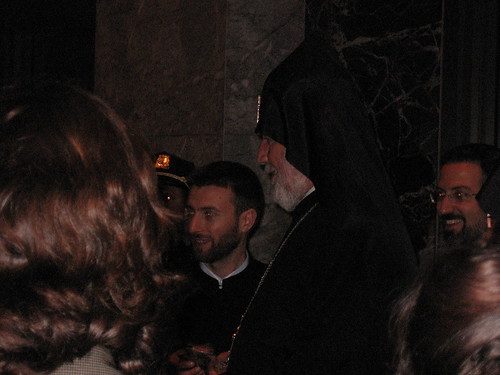
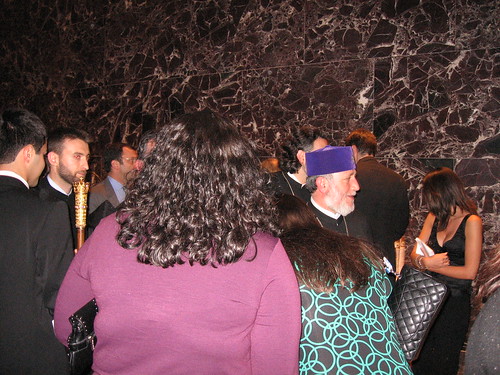
Vehapar is the one in the purple hat. Just in case you couldn't figure that out.
More on today's Hrashapar service in the next post.
* non-Armenian
The program was really nice; I got to trot out Mer Hayrenik for the crowd singalong at the beginning, which I learned during my time crashing the youth choir at my old church. There are still so many times when I don't know ANYTHING about what is going on, so it was great to feel a little smug like, "hey! I actually know something now!" One of the big highlights of the evening was the Sayat Nova dance company , who were just terrific. I hadn't seen them dance before. Then the Catholicos stood up and said a few words about how happy he was to see that Armenian culture was still being carried on and flourishing here in the diaspora. I think you probably only see this in places like LA, Boston, maybe Detroit, where there is a large Armenian population. Since I grew up in a place with not that many Armenians, I didn't have the opportunity to go to Armenian School (the community did try to put one together when I was really little, but it wasn't really a success), or have my mom force me to take Armenian dance lessons. I think that the Internet is great for Armenians across the Diaspora, because at least now, even if you are in a small community, you can still learn and be exposed to some aspects of the language and culture.
A comment on a previous post suggested that I add pictures, and I now have some! Most of them are pretty awful, though. Our camera has never been the same since it fell off a rock during my husband's hiking trip this summer. Here are two pictures from the Young Professionals' event on Friday night. The first one is before the ceremony, and the second one was taken afterwards.
Vehapar is the one in the purple hat. Just in case you couldn't figure that out.
More on today's Hrashapar service in the next post.
* non-Armenian
Monday, February 05, 2007
The Feast of St. Sarkis
Two Sundays ago was a feast day, celebrating the life of one of the many Armenian martyrs, St. Sarkis. St. Sarkis was a warrior and a Christian, killed by a Persian king after fleeing the Emperor Julian. The lives of the Armenian Saints are filled with stories like these (stories similar to those of the early Saints celebrated by the Catholic church as well)- people being tortured and killed because of their Christian beliefs.
Armenians are not alone in this kind of history; persecution has gone on since the beginning of time, but as a people who have faced it relatively recently in their history, both on a historic scale (e.g. the Genocide), as well as on a small-scale daily basis (Armenians in the Middle East diaspora were Christians surrounded by Muslims, although many, many of them have emigrated elsewhere) we are very sensitive to the necessity of sticking to our beliefs in the face of all outside pressure.
I started writing this post a couple of weeks ago, but the sermon last week tied into the post that I had in mind. It was about St. Sahag, who was Catholicos, was instrumental in the development of the Armenian alphabet by St. Mesrob Mashdots, and the two of them have a joint feast (the Feast of the Holy Translators), although according to my church bulletin, Saturday Feb. 10 was the Feast of Sahag Bartev. So maybe he has his own?
Usually St. Sahag is depicted as one of the main characters who ushered in the "golden age" of Armenian culture, but this week, we were recognizing him for something different. St. Sahag stuck up for the monarchy, which made him really unpopular with the ruling Armenian princes, and eventually had to step down as Catholicos. He maintained his popularity with the people, though, who recognized him as someone who was true to his beliefs.
Historically, in the face of tremendous pressure and persecution, Armenians have remained true to their Christian faith. They have suffered, been discriminated against, and even been killed en masse over it.
I think that this is why,
when two FoxNews reporters were kidnapped by Muslim extremist groups and converted to Islam in order to be released, I did not know if I could have done what they did. I would have felt extremely guilty. Armenian heritage stands upon the bones of many, many people who died rather than betray their faith, what they believed to be true. I think that part of me would have seen conversion, however insincere, to be a betrayal. I know that if I were killed because of a refusal to convert, my husband, father, and mother would all be upset, although maybe my mother would have understood better than anyone else.
The sermon on that day was about St. Sahag, and all people who are truth-tellers. Telling the truth is not always popular; especially when that truth is something that people don't want to hear. Have you ever told a friend or loved one that the person they're dating is controlling or abusive? Just see how popular THAT is. Usually what happens is that the person will quit talking to you, and eventually either break up with or divorce the dodgy significant other. Sometimes your friend will come slinking back, embarrassed by the fact that you were right, but sometimes not.
What was especially interesting about this sermon was that the priest walked his talk. This church is in an extremely, extremely conservative area, and I wouldn't categorize the membership as especially liberal. The priest proceeded to elaborate his message with the modern-day example of the Iraq War, and how no one wanted to come forward to say that it was a bad idea and our reasons for going in were spurious. Those who did say those things were demonized by the administration, but time is bearing them out, and more and more voices are joining in to support them.
I confess that I was shocked. And impressed.
Armenians are not alone in this kind of history; persecution has gone on since the beginning of time, but as a people who have faced it relatively recently in their history, both on a historic scale (e.g. the Genocide), as well as on a small-scale daily basis (Armenians in the Middle East diaspora were Christians surrounded by Muslims, although many, many of them have emigrated elsewhere) we are very sensitive to the necessity of sticking to our beliefs in the face of all outside pressure.
I started writing this post a couple of weeks ago, but the sermon last week tied into the post that I had in mind. It was about St. Sahag, who was Catholicos, was instrumental in the development of the Armenian alphabet by St. Mesrob Mashdots, and the two of them have a joint feast (the Feast of the Holy Translators), although according to my church bulletin, Saturday Feb. 10 was the Feast of Sahag Bartev. So maybe he has his own?
Usually St. Sahag is depicted as one of the main characters who ushered in the "golden age" of Armenian culture, but this week, we were recognizing him for something different. St. Sahag stuck up for the monarchy, which made him really unpopular with the ruling Armenian princes, and eventually had to step down as Catholicos. He maintained his popularity with the people, though, who recognized him as someone who was true to his beliefs.
Historically, in the face of tremendous pressure and persecution, Armenians have remained true to their Christian faith. They have suffered, been discriminated against, and even been killed en masse over it.
I think that this is why,
when two FoxNews reporters were kidnapped by Muslim extremist groups and converted to Islam in order to be released, I did not know if I could have done what they did. I would have felt extremely guilty. Armenian heritage stands upon the bones of many, many people who died rather than betray their faith, what they believed to be true. I think that part of me would have seen conversion, however insincere, to be a betrayal. I know that if I were killed because of a refusal to convert, my husband, father, and mother would all be upset, although maybe my mother would have understood better than anyone else.
The sermon on that day was about St. Sahag, and all people who are truth-tellers. Telling the truth is not always popular; especially when that truth is something that people don't want to hear. Have you ever told a friend or loved one that the person they're dating is controlling or abusive? Just see how popular THAT is. Usually what happens is that the person will quit talking to you, and eventually either break up with or divorce the dodgy significant other. Sometimes your friend will come slinking back, embarrassed by the fact that you were right, but sometimes not.
What was especially interesting about this sermon was that the priest walked his talk. This church is in an extremely, extremely conservative area, and I wouldn't categorize the membership as especially liberal. The priest proceeded to elaborate his message with the modern-day example of the Iraq War, and how no one wanted to come forward to say that it was a bad idea and our reasons for going in were spurious. Those who did say those things were demonized by the administration, but time is bearing them out, and more and more voices are joining in to support them.
I confess that I was shocked. And impressed.
Thursday, January 18, 2007
Dear Eric Bogosian,
In this week's Newsweek magazine, there is an article asking a bunch of celebrity baby boomers what is next on their To-Do lists. One of them was Eric Bogosian, and the first thing on his list was "Learn Armenian."
Well, for Mr. Bogosian and anyone else out there who would like to learn Armenian, let me point you towards some resources. My resources are almost all for Western Armenian, because that is what I am trying to learn.
Language Tapes
I think the best one out there is Pimsleur's Western Armenian. Pimsleur has a an Eastern Armenian version as well. I actually wrote the lone user review, so I won't repeat it here.
Another option, not as good, is the VocabuLearn series. I haven't listened to Level 2. The lone review of this product is also mine. I should note that I wrote it before the Pimsleur was available. If you have to pick one, go with Pimsleur; it is much better. I think the VocabuLearn is only 3 stars in comparison. I may see if I can go back and edit it.
Books
One of my favorite resources, Armenian Dictionary in Transliteration by Armenian language guru and fellow Penn grad Thomas Samuelian, is no longer in print. I am not sure that it is worth the $100 for a used copy through amazon.com, but you may be able to find it through a church bookstore or other Armenian resource. I found mine through Hye Family, although it looks like they are no longer selling books. For people who cannot read the Armenian alphabet, this is an invaluable resource. I cannot recommend it highly enough. I wrote one of the reviews on the amazon.com page; mine doesn't stand alone, this time!
Another great resource is Modern Western Armenian for the English Speaking World by Dora Sakayan. This is worth every penny of the $60-$70 you will pay for it. There is enough transliteration to enable you to use it if you don't know the alphabet, but it will help you learn the alphabet and get better at reading. You can't buy it new from amazon.com anymore, but you can buy it from St. Vartan's bookstore (the official bookstore of St. Vartan's Cathedral in NYC). I bought mine from Abril bookstore in Glendale, CA, along with a set of children's flashcards to learn the alphabet, which help a little, but really aren't as helpful as just doing a lot of transliteration.
Sometimes your local Armenian church will offer adult Armenian classes; I advice checking with them, if you have one.
Well, for Mr. Bogosian and anyone else out there who would like to learn Armenian, let me point you towards some resources. My resources are almost all for Western Armenian, because that is what I am trying to learn.
Language Tapes
I think the best one out there is Pimsleur's Western Armenian. Pimsleur has a an Eastern Armenian version as well. I actually wrote the lone user review, so I won't repeat it here.
Another option, not as good, is the VocabuLearn series. I haven't listened to Level 2. The lone review of this product is also mine. I should note that I wrote it before the Pimsleur was available. If you have to pick one, go with Pimsleur; it is much better. I think the VocabuLearn is only 3 stars in comparison. I may see if I can go back and edit it.
Books
One of my favorite resources, Armenian Dictionary in Transliteration by Armenian language guru and fellow Penn grad Thomas Samuelian, is no longer in print. I am not sure that it is worth the $100 for a used copy through amazon.com, but you may be able to find it through a church bookstore or other Armenian resource. I found mine through Hye Family, although it looks like they are no longer selling books. For people who cannot read the Armenian alphabet, this is an invaluable resource. I cannot recommend it highly enough. I wrote one of the reviews on the amazon.com page; mine doesn't stand alone, this time!
Another great resource is Modern Western Armenian for the English Speaking World by Dora Sakayan. This is worth every penny of the $60-$70 you will pay for it. There is enough transliteration to enable you to use it if you don't know the alphabet, but it will help you learn the alphabet and get better at reading. You can't buy it new from amazon.com anymore, but you can buy it from St. Vartan's bookstore (the official bookstore of St. Vartan's Cathedral in NYC). I bought mine from Abril bookstore in Glendale, CA, along with a set of children's flashcards to learn the alphabet, which help a little, but really aren't as helpful as just doing a lot of transliteration.
Sometimes your local Armenian church will offer adult Armenian classes; I advice checking with them, if you have one.
Monday, October 23, 2006
Armenian Opera
Last night, there was an "exciting Armenian concert" (as the fliers put it) featuring two classically trained Armenian opera singers from New York City. I wouldn't have gone, but the youth choir was asked to sing with the singers when they performed Yerevan Erepouni. In traditional Armenian style, it was all very last minute, as I just go the phone call late Saturday afternoon.
It was another interesting experience with Armenian diaspora culture. One of the singers was better than the other (in my opinion), and I can't say that I loved every song, but it was nice.
It was another interesting experience with Armenian diaspora culture. One of the singers was better than the other (in my opinion), and I can't say that I loved every song, but it was nice.
Sunday, October 01, 2006
Junior Choir
So, the other part of Armenian Church, besides the Church part, is being Armenian. Sometimes, when doing things in the Armenian Church, it is less about Church and more about Armenian. I am a member of the "junior choir" now - pretty laughable considering that I am close to being 10 years older than most of the members, who are all high school students- and I am learning songs that I have never heard before, but apparently are die-hard Armenian mainstays. One is the Armenian national anthem- no surprise that I don't know this, since my mom immigrated to the US from the diaspora, not Armenia itself, and she came over way before the breakup up of the Soviet Union. How would she know the Armenian national anthem? Did Armenia even have a national anthem back in 1969? (maybe... I have no idea). We are also learning (well, I am learning, since everyone else seems to know it already) Yerevan Erepouni. Thank goodness I read music, is all I have to say! The choir director kept asking, "Do you know this song?" I didn't know ANY of them. I just said that I could read music, and I could read English, and beyond that, nothing. However, he really needs altos. Altos are prized commodities in choirs, because everyone wants to sing soprano because it's easier, and you get more glory. I wouldn't say that I'm the best alto ever, but I'm decent, and can contribute a lot. I think this is why the director has let in an almost-28-year-old into a "junior choir" full of mostly high school students. My 26 year old friend is also a member, so at least I'm not the only one.
Also, they ALL speak AND read Armenian! I am seriously the only one who can't do either. Oy. I guess I'll start picking up more musical terms. I do know "Meg! Yergu! Yerek!" so at least I know when to start singing. I am literally amazed that all these kids know Armenian. The choir director's wife explained to me that all these kids have grandparents who speak it to them, and that's why they know it. Makes sense. I didn't have a grandparent to speak it to me.
Also, they ALL speak AND read Armenian! I am seriously the only one who can't do either. Oy. I guess I'll start picking up more musical terms. I do know "Meg! Yergu! Yerek!" so at least I know when to start singing. I am literally amazed that all these kids know Armenian. The choir director's wife explained to me that all these kids have grandparents who speak it to them, and that's why they know it. Makes sense. I didn't have a grandparent to speak it to me.
Subscribe to:
Comments (Atom)

