Showing posts with label services. Show all posts

Sunday, October 07, 2007

Catholicos Visit, Part III

Today was the Hrashapar Badarak today, conducted by His Holiness. Although it was really nice that Vehapar came and was celebrating, I think that the most impressive thing was just bringing all these Armenians together under one roof, in the same building, as one church. Only His Holiness has that kind of influence to get all these people in church on this day.

I also really treasured singing in the choir. GUESS WHO HAD A SOLO???? ME!!! It was one of the two measure amens after Miayn Soorp. I had the "amen" after His Holiness said "Orhnayl Vortit Soorp, Adzvadz jushmarid". I just found out yesterday; it was kind of a last minute thing. I was so honored to have a solo, even a tiny one, during this service. Even if I didn't have a solo, though, I was just so excited to be able to do this. Ever since I found out that Vehapar was coming, I hoped I would be able to sing in the choir for this service.

Working with Maestro Mekanejian was truly an honor and a privilege. I learned so much from working with him, and it was amazing to see such faith in action. This man has so much love not only for the music, but for his church. It was so beautiful. Here is a brief article about Maestro Mekanejian. Truly, if you sing in an Armenian church choir and get the opportunity to take a workshop from him, or work with him in any capacity, you should run and jump on that opportunity.

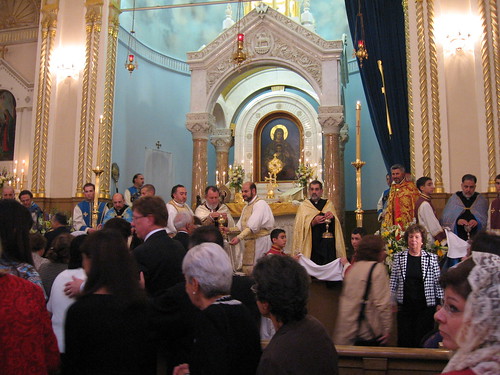
Here is the best picture from all my pictures of Friday and today. It gives you a brief glimpse of the grandness of Holy Trinity in Cambridge. It doesn't do it justice. It is a beautiful church.


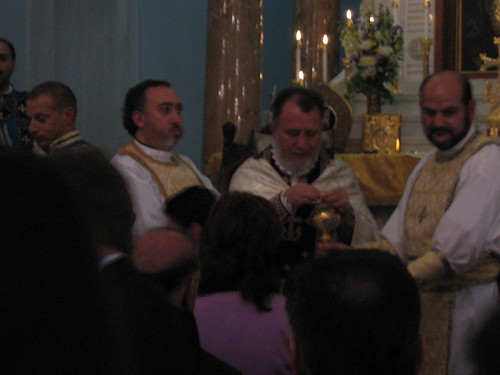
This picture is an okay one, a close-up. I was having trouble getting a good one all zoomed in. The man on the left is Very Rev. Fr. Simeon Odabashian. I don't know who the other one is.


Vehapar's message was about the importance of the Armenian family. With all that Armenians have been through during their history, the family unit has really been the place where Armenian culture and religion was nurtured and preserved. The Armenian view of the family unit is that the father and mother are king and queen of their household, and the children are their subjects over which they rule with paternal/maternal love as the guiding force. Vehapar said that in the kingdom of the family, there are no weapons and no violence. Unfortunately, that isn't the case in all families, but it certainly is the ideal that we should all be striving for. Vehapar said that we need to practice our faith on a daily basis, and this reminds me of something that my mother said my grandmother used to say: "You shouldn't have to tell people that you are Christian. They should know from your actions."

Friday, October 05, 2007

Catholicos Visit, Part I

The Catholicos, His Holiness Karekin II, is going to be in town this weekend. There are a number of events for different age groups, culminating in His Holiness celebrating badarak on Sunday.

I will be singing in the choir on Sunday; I am very excited and honored to have this opportunity. I would not enjoy the Armenian Church nearly as much as I do if I was not able to participate in the choir on Sundays. It makes me feel more involved in the service. In order to participate on this particular Sunday, I have to attend 2 rehearsals that are 4 hours long each. For the Catholicos visits, Maestro Khoren Mekanejian is conducting the choirs for every stop on His Holiness's tour through the Eastern Diocese. We had our first rehearsal last weekend, and we have another one this Saturday.

I feel really lucky to be able to work with Maestro Mekanejian, even for this brief amount of time. I have never had a proper "rehearsal" of the music for the services. The churches that I have attended didn't have rehearsals, since you do basically the same thing every Sunday. I just had to pick it up as we went along. I am not sure that I would have been able to do this successfully if I did not read music. So although the choir directors at the churches that I have attended have often been top-notch, it is hard to benefit from their knowledge without much rehearsal time. Maestro Mekanejian really worked hard with us to get everything just right- getting the pronunciation right (some folks here speak Armenian with a local accent!!), getting the phrasing right, getting the volume and beats right. It was very educational.

Sadly, there isn't a big turnout for the choir, I think because there are 8 hours of mandatory rehearsals. This is tough for people to make, but I wish more people had made the effort. There are about 20 people who are going to sing in the choir, almost all women. There are only a few men.

Why don't more men sing in the choir? I assume that this is because they all want to be deacons; the men in the choirs at the churches I have been to are all older gentleman who are past their deaconing days. At my old church, all the deacons were under the age of 30 (many many high school boys, which is so nice to see), and there are a LOT of them, so there was some talk about having them alternate being on the altar and singing in the choir, so they would learn the tenor or bass parts to the choir music, and we could have some extra men. This sounds like a great idea to me. I would love to see more men and boys get involved in the choir.

Tonight is the Young Professionals event with the Catholicos; my husband and I are going to this one. The events for the children and teenagers are tomorrow during the day, and tomorrow night is the big banquet. We are skipping the banquet because tickets are $150 a person and the YP event is free (yay!). Then there's service on Sunday. I will try to take pictures tonight, and have my husband take pictures on Sunday (if possible).

Friday, August 03, 2007

East Coast/West Coast differences

Now that I've been to three different churches here on the East Coast, I have noticed a few differences between these services and the ones at the two churches I used to frequent back West.

1) They really do morning services here- this is the service that happens before Badarak. One of my churches didn't do morning service AT ALL, and the other did it kind of quietly, and finished and had a pause before they went into Badarak.

2) At the beginning of the Badarak, the priest walks around the sanctuary with the little cross handkerchief for everyone to kiss. I had no idea what this was the first time I saw it.

3) Way more English. All the sermons are in English. I think that is because in the particular areas where I have gone to church, there aren't very many new immigrants. Maybe there are some who are my mom's age and came over in the late 1960s, but I am not sure if there are any people like my friend out in California, who came over from Baghdad three years ago. I know that there are a lot of Armenians who have come to the US from Armenia and other former Soviet republics, but I don't think they are settling in Boston. I know the Nashville Armenian community has a number of these new immigrants, as does Glendale. Even when I was teaching my undergrads, the Armenian students I had, who were 18, 19 years old, were mostly born overseas and came over to the US as children. The use of English is a welcome difference for me, since I barely speak any Armenian at all.

Tuesday, January 16, 2007

Good News!

This past Sunday was the Merelotz Badarak; meaning that after Badarak, Hokehankist (literally "spirit rest") is meant to remember all of our dead. Merelotz means either "dead" or "death"- I am not totally sure, but definitely one of those.

The priest explained that the Sundays after big feast days (namely, Christmas and Easter), we always have a Merelotz Badarak. This is because Christ being born and rising from the dead is not only good news for the living, but good news for those who are "asleep." The priest explained that we don't think they are dead, just "asleep" until the second coming, or judgment day, or whatever it is that is supposed to wake them up from death. Merelotz Badarak seems especially important to me after Easter, because the priests don't say Hokehankist at all during all of Lent, nor for Easter. In general, big feast days = no Hokehankist. I suppose that this recognizes that there is a time for everything, and while we never forget our dead, some days should not be marred by mourning. Seems sensible to me.

The sermon this week was an interesting one. It was all about Jesus as the source of all good things, as exemplified by the first miracle that Jesus carried out. For those of you who aren't familiar with the New Testament (indeed, my own knowledge is somewhat sketchy, as I am able to name 2 of Jesus's miracles, but not the third one), the first miracle was Jesus turning water into wine at the wedding at Cana.

The priest made a really good point. Jesus's first miracle was to promote the individual enjoyment of people, to let them have a good time. This runs contrary to some of the doctrines of more puritanical churches who forbid alcohol, dancing, etc. It shows that God is the source of all good things and shows that He wants us to enjoy ourselves and celebrate. Sounds good to me!

Wednesday, January 10, 2007

On Being A Visitor

While we were away last week, I took the opportunity to visit a local Armenian Church to celebrate the Theophany, and get my yearly rationing of holy water. I was pleasantly surprised at how friendly and welcoming this church was. This is the first time I've been to an Armenian Church where someone actually talked to me first. I admit, I was shocked. Before I even sat down, someone came over to introduce himself and ask me where I was from, etc. Turns out there had been a young adult party at his house the night before, and he also had another person there who was in town for the same conference that brought me to the area.

Since I like to give credit where credit is due, the church I visited was St. James Armenian Church in Evanston, IL. They have a young priest (a "Deacon-in-Charge" actually, which seems to be the step before becoming a Der Hayr? Not sure.), but on Sunday, they had a visiting priest from Detroit conducting Badarak.

In my regular church, the way they get through the service in the fastest way possible is to leave things out. For instance, instead of starting with Khorhoort Khoreen (Profound Mystery), we start with Miadzin Vorti (Only Begotten Son). This visiting priest, who was not very young (to be polite), had been around (in a church way), so his method of keeping the service snappy was to say the whole thing very, very fast. I was following along with the pew book (the brown one!), and it was tough. He was going FAST. Not just normal quick conversational speed, but the speed you hear when someone is saying the fine print at the end of a radio commercial.

Because it was Christmas, church was packed. It wasn't a big church (at least, the sanctuary wasn't big; the building itself seemed like it had lots of room), and you could tell by looking at the outside of the church that it hadn't originally been an Armenian church. If an Armenian church is built to be an Armenian Church, it is built in a very specific style. However, Armenians are a resilient people, so we will happily take a church that used to be Methodist, Baptist, Episcopal, or whatever this denomination used to worship there, and make it our own. On the inside, it looked like the other Armenian churches that I had been to. You have a place to light candles (where in the church this is located seems to vary from church to church), a raised platform where the faithful go up and receive communion and where the priest gives his sermon (this is one step up higher from where the congregation sits), and then you have the altar, which is raised up much higher than the congregation. You have to climb several steps to get up there, usually 3-5. You have the curtain that gets closed during part of Badarak (or the whole Badarak, as happens during Lent), the marble-looking altar thing (surely it can't really be marble, can it?), the gold crosses, the picture of Jesus and Mary (this church had a very European, Vermeerish looking picture instead of a more traditional Eastern-style, 2-dimensional iconograph).

When Badarak started, I was the only person in the congregation. No real surprise, since Armenians always run late. The church gradually filled up, and I ended up sharing my pew book with a Northwestern Ph.D. student originally from Glendale. I could tell from the way she was sneaking looks at my pew book that she needed one too, so I asked her if she wanted to share. Even though I have been attending church regularly for over a year now, I still need the book to know where we are, what is happening.

On the train from downtown, I was cramming like crazy to learn the two lines I needed to learn. First was the Christmas exchange. It goes like this:

Armenian #1: Krisdos dznav yev haydnetsav! (Christ is born and revealed among us!)
Armenian #2: Orhnyal eh haydnotyoonun Krisdosee! (Blessed is the revelation of Christ!)

I figured that I didn't really need to wish anyone Merry Christmas, so all I had to learn was the response, which was the same as the other exchange I was trying to learn last minute, the exchange for the Kiss of Peace. Protestant/Catholic churches also do some kind of passing/exchanging peace, usually consisting of shaking the hands of your neighbors seated around you and saying "Peace be with you." In the Episcopal churches that I have attended, Exchanging the Peace practically turns into coffee hour, with everyone going all over the church to say hi to their friends, talking to random strangers, and it tends to go on for 5 minutes or so, until the priest reins them all in.

In the Armenian Church, despite our deserved reputation for being loud, noisy, and social, we are very regimented when it comes to the Kiss of Peace. The deacon-in-charge (not always the priest) usually goes down, and starts the chain by "kissing" two of the other deacons, who then go out and distribute the "kiss" in the manner of playing Telephone down each row.

Let me clarify. There is no actual kissing involved. It's basically the miming of a European-style, double-kiss greeting on both cheeks, but instead of kissing, the person doing the kissing whispers Krisdos ee mech mer haydnetsav (Christ is revealed among us).

Then, the person receiving the kiss whispers back the same line you reply with for Christmas: Orhnyal eh haydnootyoonun Krisdosee. After you receive the kiss, you turn to your neighbor, move your face from one of their cheeks to the other, whispering Krisdos ee mech mer haydnetsav, and they reply back Orhnyal eh haydnootyoonun Krisdosee, and repeat.

The reason why I don't know these two lines is because a) Christmas only comes once a year, so it's not like I get to practice and b) with the Kiss of Peace, being in the Choir gets me out of participating, so I never had to learn. (It is kind of a relief- one fewer thing that I have to screw up on a regular basis). On the one hour train ride from downtown Chicago to Evanston, I kept repeating (sometimes out loud, but quietly) "Orhnyal eh haydnootyuonun Krisdosee! HaydnooTYUNun. HaydnooTYUNun. HaydnooTYUNun." And then I get to church, and I STILL screw it up. No one seemed to mind, though, and when the "kisser" got to me, he said it in English to make sure I understood.

Afterwards, I went up to the Deacon-in-charge and told him that he had a very friendly church, and I was very impressed. He asked my name, and I told him, and then he asked my last name. I repeated my very, very WASPY, not Armenian at all, last name (both married and maiden name are this way), and added "I am only half Armenian." He told me that did not matter at all, and not to even mention it, I was still Armenian, etc. My sister, in all of her experiences with the youth programs with the Eastern Diocese, has said that this attitude of "We're all Armenians!" is not universal, so I admit that I kind of expect it wherever I go. I'm only half, I don't speak much Armenian, etc. I told him "Keech me ge khosim." (I speak a little), and hey, he was happy.

My husband and I are just starting the process of finding out where we will be living starting next year. I am pleased to realize that everywhere he is interviewing is no more than about an hour away from an Armenian Church, and most are much closer than that.
Monday, November 13, 2006

Armenian Funerals

I went to my second Armenian funeral last week, for the 21 year old deacon who died. The first Armenian funeral I attended was for my grandfather, and it was an Armenian priest that my family had flown into town to do the service. (Hayr Simeon is a great guy, by the way, and I love his philosophy on getting people involved with the church. If you live in the Providence, RI area, you should definitely check out his church.)

The viewing was on Wednesday night, and the funeral was on Thursday. Wednesday night wasn't really a "viewing," though, as the casket was closed, and it was mostly people talking about this young man (some in Armenian, and some in English), like would happen at a regular funeral. Even the Archbishop was there. The church was PACKED both Wednesday night and Thursday morning. I sang with the choir on Thursday- We sang just Kahanayk and Ee Verin Yeroosaghem.

Ee Verin Yeroosaghem is probably one of my favorite hymns in the Armenian Church. The translation is:

In the Heavenly Jerusalem, in the abode of angels, where Enoch and Elijah live dove-like in old age, being worthily resplendent in the Garden of Eden; O merciful Lord, have mercy upon the souls of our departed brethren.

The imagery is so beautiful- angels, doves, resplendent gardens... it's a reminder of beauty in an otherwise pretty gloomy service.

There is a big difference between funerals for old people (like my grandfather) and young people (like this 21 year old deacon). You expect old people to die; that is what happens when you are old. You don't expect young people to die; you expect them to graduate from college, travel, buy first houses, get married, have babies, get promoted, etc. Funerals for young people are shocking to the system. Even if it's not your first funeral for a young person, it's still pretty horrifying. Just seeing all his young friends, only about 5-7 years younger than I am, going through this was just really upsetting. There was a huge HUGE presence of the Homenetmen; they had the flags of all the local chapters, plus another one from elsewhere in the state, on display by the coffin, all the scouts were there in their uniforms, and they had draped a Homenetmen flag on his coffin.

Almost all the service was in Armenian again, except for one of the priests (the former priest of this church), who graciously translated his speech into English. This was much appreciated by me (and I am sure by the deceased non-Armenian friends), not only b/c it meant that I would understand what was going on, but because I didn't really know this young man, so it was nice to hear comments from people who did know him.

I was fine until the end, when his pallbearing young friends went to get the coffin. No one should have to be a pallbearer for their friend at that young of an age. It is just not fair. I started crying, and his mother lost it. The family was practically restraining her from throwing herself on the coffin. She was screaming and crying. Naturally. At first I had kind of a negative reaction to this, but then I thought, "If there is ever at time when screaming and bawling is warranted, it's now. Why should she try to hold everything in? Let her scream and cry." I told my husband this, and he said that he was reminded of the show Six Feet Under- whenever anyone at a funeral starts to lose it, David will hurry them off to the private room off to the side so they don't make anyone uncomfortable, and Nate gets mad, because it is all so fake to stifle grief like that. Death is sad. Let people be sad.

There was a lot of emphasis in the services on "he is in a better place now." This always annoys me, because this is supposed to make me feel BETTER? I am selfish- I want (whoever) here with me NOW. I told my husband that if I die early, my funeral is not to be entirely in Armenian, and that none of this "better place" crap.

Tuesday, November 07, 2006

Bullet Point Sermons

The sermons at my church crack me up. As I've mentioned before, sermons are not really the main focus in the Armenian Church, so often they are an afterthought.

The priest at the church that I usually attend (I should come up with nicknames for the two churches- maybe later) actually is very good at preaching in Armenian. I don't understand Armenian, but you can tell. Most Sundays, he will read an English translation of his sermon either before, or intersperse the translation throughout the Armenian sermon. He just isn't as comfortable with English.

What is always so funny to me is that the English sermon can always be summed up in one or two bullet points. I make a point to come home and tell my husband what the bullet point for the week is. They are usually very good messages, although unlike at most Protestant churches that I have been to, unconnected to whatever the Bible reading of the day is. I am not sure if the Armenian sermons can be summed up quite so nicely.

Recent bullet points:

  • God Gave You Brains: Use Them (Or Lose Them).
  • Nobody Is Perfect, followed a few weeks later by
  • Be Above Average


And my personal favorite of all time:

  • God Doesn't Like Losers